I really enjoyed working on this post—it’s been a while since I sat down and revisited all the specific ways acupuncture helps the body heal. One of my first thoughts was:
“Oh! Look at all these great things I do at work each day. Nice!”
In the clinic, I usually keep things broad when explaining how acupuncture works. That’s partly to keep it relatable for my patients, but if I’m honest, sometimes I also forget the specifics—I’m focused on the work itself, not the mechanisms underneath.
Before we get into what the research says, I want to share a metaphor I often use to explain how acupuncture helps reduce pain.
🏋️♂️ Acupuncture as Exercise
Strength training is a hobby of mine, and so I’ve learned that when you do a bicep curl, you’re not immediately growing your biceps brachii muscle. You’re causing micro-tears, triggering a release of endorphins, and setting off a healing cascade: increased circulation, immune activation, growth hormone, tissue repair. Most of that “magic” happens later—especially during sleep—when the body adapts to the stress you just gave it.
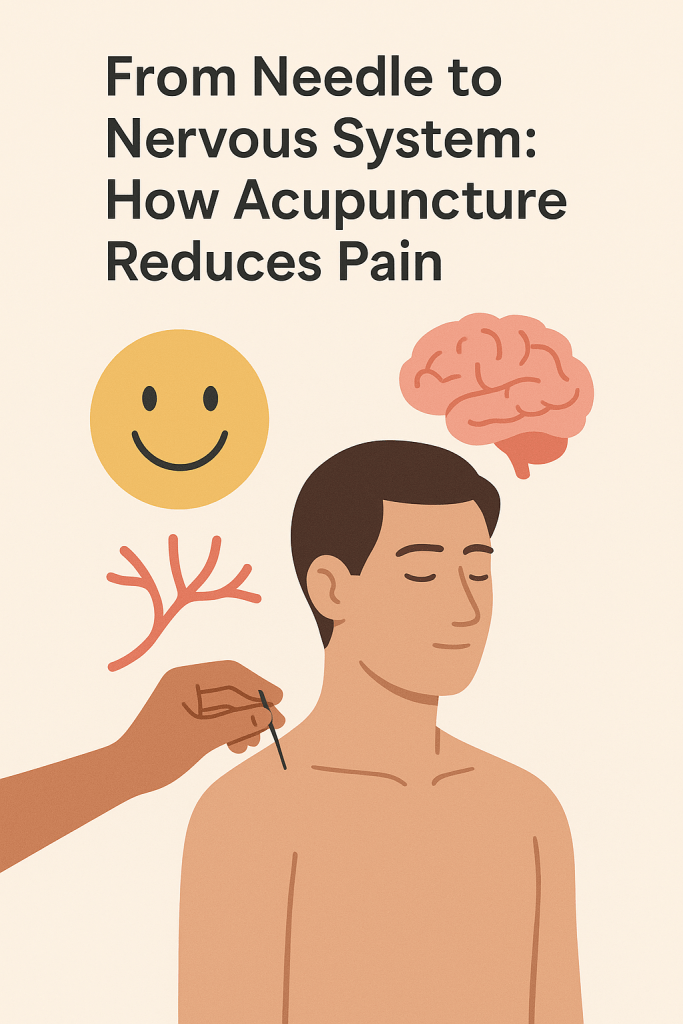
Acupuncture works similarly. When a needle enters the tissue, it’s a gentle, targeted disruption—a stimulus that the body responds to with a series of healing actions. As you’ll see below, that response includes everything from increased blood flow to reduced inflammation to the release of your own natural painkillers.
So what we’re doing is twofold:
- Immediate relief – Downregulating pain signaling in the nervous system.
- Long-term healing – Supporting circulation, reducing inflammation, and easing tension so real progress can happen over time.
Acupuncture can support many different conditions, but for today—and for the primary focus of my clinic—we’re talking pain.
📊 Summary: How Acupuncture Helps Reduce Pain
| Effect | Mechanism | What Research Shows |
|---|---|---|
| ⬆️ Local blood flow | Vasodilation via neuropeptides (like CGRP, Substance P) and nitric oxide | Increased circulation at needled sites; enhanced healing response |
| 🌿 Muscle/fascia release | Mechanical stimulation of connective tissue and myofascial modulation | Needles create local tissue stretch and relaxation, reducing muscle tone and tightness |
| 😊 Pain relief | Release of endogenous opioids (endorphins, enkephalins, etc.) | Natural painkillers released; pain pathways inhibited in brain and spinal cord |
| 🔥 Inflammation reduction | Suppression of pro-inflammatory cytokines; immune system modulation | Lower levels of IL-6, TNF-α, and other inflammatory markers after acupuncture |
| 🧠 Nervous system shift | Activation of parasympathetic system; modulation of brain pain perception | Changes in limbic system and somatosensory cortex; improved nerve conduction (e.g., CTS) |
🧠 Digging Into the Research
1. Nerve Stimulation & Circulation
Inserting a needle activates local sensory nerves, triggering neuropeptide release (e.g., Substance P, CGRP), which leads to vasodilation and increased blood flow around the point.
At the Zusanli point (ST36), stimulation increases cerebral blood flow via nitric‑oxide–mediated vasodilation and reduces inflammatory markers like IL‑6.
2. Muscle Relaxation & Connective Tissue Response
Research indicates that needle insertion mechanically deforms tissues—including fascia—which may relax tight muscle fibers and reset tension via connective‑tissue modulation.
3. Endorphin & Opioid Peptide Release
Acupuncture—especially electro-acupuncture—stimulates the release of endogenous opioids like enkephalins, β‑endorphin, endomorphin, and dynorphin. Different stimulation frequencies affect which peptides are released. These peptides block pain signals in both the central and peripheral nervous systems, similar to morphine, but naturally produced by your body.
4. Anti-Inflammatory Effects
Acupuncture exerts strong anti-inflammatory effects by reducing cytokine release, suppressing inflammatory cell activity, and recruiting neutrophils that help resolve local inflammation.
In stroke patients, it has even been shown to improve neurological recovery by dampening inflammatory processes.
5. Modulation of Pain Signal Processing
There’s evidence that acupuncture inhibits hyperactive pain pathways: reducing activity in pain-related ion channels, suppressing glial cell activation, and stimulating descending inhibitory systems that release serotonin, norepinephrine, and opioid peptides.
In carpal tunnel syndrome, real acupuncture (especially electro-acu) improved nerve conduction and triggered cortical brain remodeling—while sham acupuncture yielded only temporary symptom relief.
🧾 Conclusion
The World Health Organization (WHO) has recognized acupuncture as a potentially effective treatment for over 100 conditions—ranging from migraines and digestive issues to anxiety, allergies, and infertility. Each of those conditions involves its own unique physiological patterns, and in each case acupuncture works through a wide range of mechanisms to support the body’s return to balance.
For today though, addressing some of the ways in which acupuncture helps with pain seems like plenty—both by calming the nervous system and by supporting long-term healing where the body needs it most.
 Dunbar Acupuncture And Wellness