On a Personal Note

Hello there! I’ve been focusing on keeping this blog limited to clinically relevant information, my advice and perspective around healing. This bit below isn’t entirely opposite of that, but the original purpose of the words was fulfilling my desire to share a bit about myself on my social media accounts.

Still, I think it can be helpful sometimes to know who you’ll be talking to in a session, assuming you don’t just start snoozing! I do my best to translate my perspective to fit whoever I’m working with, but the bits below are closest to my unfiltered perspective on people and life.

If you don’t know the folks in the first line, feel free to look them up, both have a pretty strong online presence, and a lot of good talks & writing. Without further ado:


I think my perspective on life is 50% Alain de Botton, and 50% Ram Dass. Half psychology, and half spiritual.

The former essentially says we’re each individually kind of a mess and that’s okay. The latter saying essentially that we’re unified ultimately by an infinitely wise and loving Oneness.

I think either perspective might be hard to take on depending on the person. Of the two I think the psychology is easier to argue, certainly easier to study and prove that we all have various neuroses and coping mechanisms we pick up. We all have our aspects of enduring immaturity and ridiculousness, and yet somehow we muddle through. I think many people make the mistake of thinking they’re uniquely messed up when I think the awareness and willingness to continue to work on oneself is the unique part, not the wounds.

The spiritual side is one I’ve long struggled internally to argue. And I’ve concluded, it’s not something meant for debate. I don’t think there’s any particular words that can beat out a single heart breaking story of life’s horrendously challenging ways.

I think it’s experiences of loss, prayer, meditation, psychedelics, various ways people come to actually touch and connect with this universal Love that changes people in ways that words just can’t adequately convey.

And in that way psychology and spirituality are similar: people have to find the humility to choose to try something different. Usually it’s through significant hardship that people really put in the work to second guess their own viewpoint of the world. And despite however much good intention exists, no one can do that work for someone else.

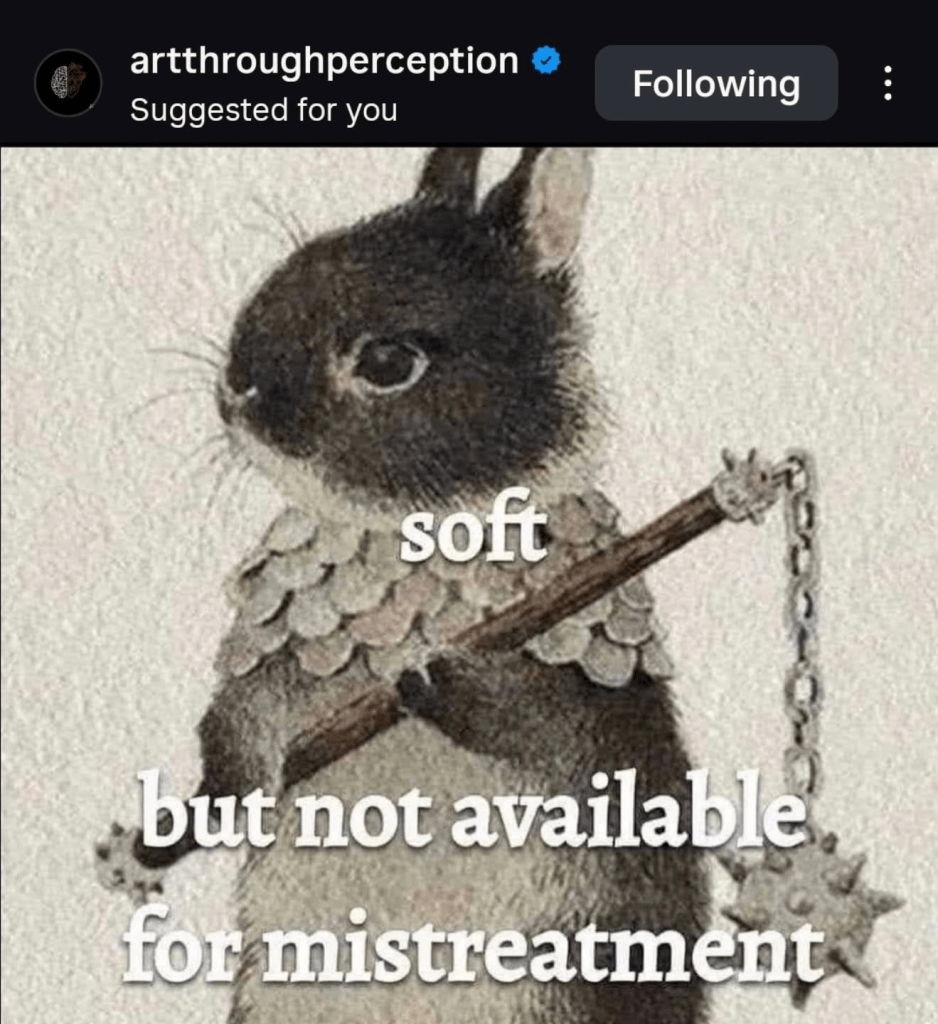
I really like this rabbit, to me it symbolizes vulnerability and boundaries. The capacity to love one’s self enough to protect yourself.

I think its helpful to acknowledge both, that we’re so foundationally all in this together and that life can be confusing and scary and cause people to act unkind and harmful out of ignorance and fear.

So, here’s to all of us, here’s to being kind and loving to ourselves and each other. And to this badass rabbit with a morning star flail thingie. 

The Problem with Energy Work – According to One Energy Worker

The most well-known form of energy work is probably Reiki. But there are many other modalities that could fit under that umbrella — chakra and aura work, muscle testing, sound healing, breathwork, therapeutic qi gong, acupuncture, massage, homeopathy and some types of botanical treatment.

All of these share one central idea: one person seeks to shift or harmonize the energy of another.

And overall, I think these practices can be deeply helpful — in the right context. When someone finds a modality that truly resonates, it can open the door to real healing. In my view, what we often call “spiritual” work overlaps strongly with physiological safety: parasympathetic activation, emotional regulation, and the gentle processing of subconscious trauma.

Good energy work, at its best, helps us step back from who we think we are and see ourselves from a new lens.

But — as promised in the title — the problem is this: energy work is subtle work.
And subtle things are hard to measure.

I’ve met many so-called energy workers who are, frankly, not very good at what they do but believe themselves to be gifted healers. Because the results of energy work are often subjective and difficult to quantify, even the practitioners themselves may not know when they’re truly helping.

That doesn’t make it impossible to measure — just complicated.
And that complexity often gets bypassed by mutual good intentions.

A client wants to be healed.
A practitioner wants to help.
Both want to believe something meaningful happened.

But two people agreeing that something felt good is not a reliable measure of change.

In my opinion, the real challenge lies not in how to measure, but in who can bear to look. To evaluate your impact honestly, you have to face the possibility that you failed — or worse, that you might have unintentionally caused harm. That’s a serious ego check for anyone attached to being “the intuitive healer” or “the gifted empath.”

The attachment to being a great healer or savior is the biggest blocker to realistic self-evaluation.

Stepping back from that attachment helps you grow — both through more accurate self-assessment and through better client feedback. When clients sense that your self-esteem doesn’t depend on being told the treatment was a success, they’re far more likely to be honest about their experience. That honesty is what allows your work to improve.

For a well-trained dancer, graceful, effortless movements are the result of countless mistakes and long, grueling hours of practice. Similarly, effective energy workers must wrestle with uncertainty.

Since the results aren’t easily measured, a dedicated practitioner should be constantly asking: Did I do it right? That doesn’t mean second-guessing yourself mid-session — confidence is part of the art — but reflection afterward is essential. And the clearest sign you’re doing that well is that it feels uncomfortable.

To care deeply about others while consistently acknowledging uncertainty about your own impact is not an easy path. Real healing work demands that you cultivate a big enough inner container to hold both a passion for healing and uncompromising honesty with yourself.

When I reflect on my time at the National University of Natural Medicine, I saw both options firsthand.

The most popular naturopathic doctors and acupuncturists were often charismatic — near cult figures — utterly confident in their brilliance. Yet there were few, if any, consistent measures showing their “subtle” herbal or homeopathic treatments made a real difference.

The doctors who did make measurable improvements in patient outcomes were different. They were humble. Sometimes anxious. They cared enough to doubt themselves. That anxiety wasn’t weakness — it was evidence of integrity. It pushed them to research more, verify their results, and keep growing.

To sum up, energy work is subtle, and subtle work is inherently hard to measure. With outcomes that lack objective assessment metrics, we must rely on our own intuition, honest reflection, and the sometimes inconsistent feedback of clients. I believe the key—beyond years of study, practice, and hopefully quality mentorship—is cultivating a deeper curiosity for truth than attachment to our own sense of self.

It’s an absurdly large chasm between the sense of oneself as either a gifted healer or delusional quack.

“Energy work is subtle, and subtle work is inherently hard to measure. With outcomes that lack objective assessment metrics, we must rely on our own intuition, honest reflection, and the sometimes inconsistent feedback of clients. I believe the key […] is cultivating a deeper curiosity for truth than attachment to our own sense of self.”

That’s the too-long didn’t read version of today’s blog, “the problem with energy work – according to one energy worker”.

As someone who makes their living doing at least in part some form of energy work, obviously I don’t want the baby thrown out with the bath water, but there’s some junk energy work out there. Let’s talk about it.

Go to: DunbarAcu.com/blog to read more.

How I Choose to Live: The Best Advice I Have

When I was 16 years old my mom asked me if I wanted to go with her to see Wayne Dyer speak. I agreed and went to a talk that I found very moving. In this talk Wayne mentioned a book called Power Vs Force by David Hawkins. The book had this sort of ranking system for spiritual truth, and it ranked Buddhist teachings very highly, so I started reading Buddhist books.

Along with taking up meditation, reading Buddhist books and taking their principles to heart changed me deeply. I’ve always had a curious mind, and wondered about many things, but meditation and Buddhist teachings helped me to go from thinking my way through life to getting in touch with a sort of intuition and, I believe, a deeper intelligence inside.

While nothing can replace practice via meditation or presence in and with ourselves—deep, probing honesty about our own emotions and thoughts—I believe there are principles that help me to get a feel for my best way forward when I’m not so sure.

There are two key concepts that I’ve used and considered so many times that they’ve sort of melded together in my mind. Those concepts are the Middle Path from Buddhism, and Yinyang from Daoism and ancient Chinese philosophy in general.

Both frameworks to me are particularly poignant because they are deeply self-relative—that is, they don’t give any rigid anchor point for all people, but instead engage one’s own intuition to self-define the edges of being overly rigid or abandoning ourselves through excessive indulgence.

At their best interpretation, these concepts are also self-referential. We don’t have to become obsessed with the Middle Path, or seek to avoid all discipline or enjoyment. It’s about learning the flow of our own soul—getting a feel for where we could feel more self- and life-aligned if we were to face the present moment’s gifts directly, rather than obsessively planning, catastrophizing, or running to distractions.

I’m reminded yet again of Rumi’s iconic poem:


The Guest House — Rumi

This being human is a guest house.
Every morning a new arrival.

A joy, a depression, a meanness,
some momentary awareness comes
as an unexpected visitor.

Welcome and entertain them all!
Even if they’re a crowd of sorrows,
who violently sweep your house
empty of its furniture,
still, treat each guest honorably.
He may be clearing you out
for some new delight.

The dark thought, the shame, the malice,
meet them at the door laughing,
and invite them in.

Be grateful for whoever comes,
because each has been sent
as a guide from beyond.


The point is that the concept of ☯ Yinyang and the teaching of the ☸ Middle Path aren’t about meticulously curating what we allow ourselves to feel, but instead about being present with what is, and learning to conduct ourselves in a way that brings us into harmony with our lives in each moment—rather than constantly trying to push away discomfort.

The surprising reality of life is that suffering openly faced can carry a beauty and a profound peace, while running from our emotions or experience—even if sometimes necessary—can become a habit that feels much worse than the experiences or realizations we’re trying to avoid.


The Key

Both of these principles are largely part of helping us detect and adjust when we’re no longer truly present with ourselves, feeling our feelings, accepting what is. I believe that while it is at times quite difficult, the key to a good life through the suffering is finding this balance where we may at times let ourselves go a little more soft or a little more hard, but we do so with intention, honesty, and awareness.

The result is a life that flows. A life that’s dynamic and beautiful. One that isn’t stagnant, stuck in static narrative that limits our potential and our joy.

The practice requires us to get out of our own way again and again. Second guessing our habits of mind, our presuppositions. This can be quite challenging, but the result is freedom, peace, wellness, harmony. Even when we’re sad we can be gentle and attentive in tending to our sadness and move through it into brighter days.


Finally, the Concepts Themselves

To be honest, what follows is very basic ChatGPT responses to “What is the Middle Path” and “What is Yinyang.” I encourage anyone interested to read the Tao Te Ching and, if you’d like to retrace my own beginnings, check out the first Buddhist book I read: Awakening The Buddha Within by Lama Surya Das.


☸ Middle Path

Origin
The Buddha taught the Middle Path after realizing that neither a life of indulgence (pleasure-seeking) nor a life of extreme asceticism (self-denial) led to true freedom.

Balance
It’s about finding the wise middle ground where you aren’t pulled off course by extremes.

Application

  • In behavior: avoiding both overindulgence and harsh self-punishment.
  • In thinking: not clinging too rigidly to views, nor rejecting discernment altogether.
  • In practice: following the Noble Eightfold Path (right view, right action, etc.) is considered walking the Middle Path.

Analogy
It’s like tuning a string instrument: too tight (asceticism) and it snaps, too loose (indulgence) and it makes no sound. The middle way gives harmony.


☯ Yinyang

Overview
Yinyang (often written yin-yang) is a foundational concept in Chinese philosophy, especially in Daoism and traditional Chinese thought. At its core, it describes how seemingly opposite or contrary forces are actually complementary, interconnected, and interdependent in the natural world.

The Two Sides

  • Yin (阴): moon, darkness, coolness, stillness, receptivity, softness, the feminine, the inward.
  • Yang (阳): sun, light, warmth, activity, force, hardness, the masculine, the outward.

Rather than absolute opposites, yin and yang exist in dynamic balance. Each contains the seed of the other (that’s why the familiar ☯ symbol has a black dot in the white half and a white dot in the black half).

Key Principles

  • Relativity: Something is yin only in relation to something more yang. Night is yin compared to day, but night can be yang compared to the deeper stillness of winter.
  • Interdependence: Yin cannot exist without yang, and vice versa. You only know “dark” because you know “light.”
  • Cyclical transformation: Yin and yang are always shifting into one another. Day becomes night, night returns to day. Activity gives way to rest, and rest restores energy for activity again.
  • Balance: Health, harmony, and wisdom are found in keeping yin and yang in dynamic equilibrium. Too much of one throws things out of order.