Why Exercise Isn’t the Main Key to Weight Loss

I’ve had a few patients recently tell me they don’t know why they can’t lose weight, even though they’ve been fairly active for a long time.

To me, this is a straightforward question. But it often surprises people because we’ve spent years swimming in mixed messages about weight loss. One of the persistent misunderstandings in the current zeitgeist is that the right kind of exercise is the key.

It isn’t.

Yes, the old calories in, calories out idea is broadly true, but some under-the-hood factors matter more over the long run.


The Real Drivers: Hunger, Stress, and Sleep

The essential problem with using exercise as a weight-loss tool is that our bodies naturally increase hunger signals in proportion to activity level. More exercise → more hunger → more eating.

On top of that, stress and sleep issues can push people to eat for comfort outside of true hunger signals and can disrupt our basal metabolic rate — the bulk of our everyday calorie burn, just to keep us alive.

Since BMR makes up most of our “calories out,” the real key shifts to intake and satiety. In other words:

How do we get full, and how do we stay full?


What Actually Increases Satiety

Protein, fiber, and water — in that order — do the heavy lifting for satiety.

This is why both major “diet camps” end up being partially right. Keeping fat intake somewhere around what’s needed for hormone synthesis (roughly 20–30% of total calories) is ideal. Carbohydrates can be kept relatively low, as long as you have enough for energy and daily functioning.

Unsurprisingly, properly built salads and soups can work well because they activate stretch-receptor satiety signals. But that’s not the only option anymore. There are now high-fiber, resistant-starch breads, bagels, and even rice prep methods that make fullness and blood-sugar stability easier than ever.

Protein remains the keystone, though. It directly triggers the big satiety hormones, leptin and ghrelin. Ideally, each meal should have a solid source of protein; snacking on chips alone just won’t trigger fullness in the same way.


So… Is Exercise Useless?

No — exercise is fantastic for almost everything except weight loss. It helps a little, but the bulk of the challenge is increasing awareness around intake, hunger cues, and general wellness.


Practical Tools That Actually Help

Track Your Intake (Even Briefly)

Apps like MyFitnessPal can give you a more objective sense of your true calorie intake. Many people do well through the week but “let loose” on one or two days. If you keep tracking on those days, you’ll often see how the weekly average ends up far higher than your “good day” calories — and that’s enough to stall progress.

We are very good at taking in a large number of calories at once, so consistency really does matter.

Know Your Numbers

If you’re curious about specifics, look up a TDEE (Total Daily Energy Expenditure) calculator online. Let’s say it gives you 2500 calories/day. Eating about 500 calories below that each day should yield roughly one pound of fat loss per week, assuming everything else is stable.

Just remember: water weight moves much faster than fat. Don’t let normal day-to-day scale fluctuations derail you. Trust the intake tracking, use measurements, or average your weight over a week or month to get a clearer view.

How does acupuncture work?

For a long time, I had trouble answering this question in my practice—not because I didn’t know, but because there are so many details and effects that it was hard to know where to start.

These days, I tend to compare acupuncture to exercise: I’ll say, “The ‘magic’ lies in how the body responds to a kind of good stress.” And then I’ll share a short sampler of some of the information below.

Everything that follows is from a Western physiological perspective—it doesn’t get into the traditional framework of moving Qi or energy through the body. When someone’s interested in that more energetic lens, I’m happy to talk about promoting flow and balance in as much or as little detail as they’d like. But for those who prefer a scientific explanation, here’s your answer:


Acupuncture’s mechanisms of action are multifaceted, involving both physiological and neurological pathways. While the full picture is still being refined, research across neurobiology, endocrinology, and immunology has identified several overlapping mechanisms that explain how acupuncture can produce analgesic, anti-inflammatory, and regulatory effects.

Here’s a clear breakdown of the major mechanisms of action:


🧠 1. Neurotransmitter and Neuromodulator Release

Acupuncture stimulates peripheral sensory nerves (especially Aδ and C fibers), leading to activation of the spinal cord and brain regions that modulate pain and emotion. This results in the release of several key neurochemicals:

  • Endorphins, enkephalins, dynorphins: endogenous opioids that reduce pain perception.
  • Serotonin and norepinephrine: involved in mood regulation and descending pain inhibition.
  • GABA and glutamate modulation: balancing excitatory/inhibitory signals in the nervous system.
  • Adenosine: increases locally, providing anti-inflammatory and analgesic effects.

🧩 Result: Reduced pain, relaxation, and modulation of mood and stress.


⚡ 2. Activation of the Gate Control Mechanism (Spinal Level)

Acupuncture can influence pain signaling at the spinal cord level:

  • Stimulated Aβ fibers inhibit pain transmission from C fibers (the “gate control theory”).
  • This dampens nociceptive (pain) signals before they reach higher brain centers.

🧩 Result: Decreased pain transmission and heightened threshold for pain perception.


🧬 3. Modulation of the Autonomic Nervous System (ANS)

Acupuncture appears to rebalance sympathetic and parasympathetic activity:

  • Reduces sympathetic overactivity (which is linked to stress, hypertension, and inflammation).
  • Enhances parasympathetic tone, promoting rest, digestion, and recovery.

🧩 Result: Lower heart rate and blood pressure, improved digestion, and stress reduction.


🔥 4. Anti-inflammatory and Immune Regulation

Acupuncture modulates immune cell activity and cytokine production:

  • Decreases pro-inflammatory cytokines like IL-1β, IL-6, TNF-α.
  • Increases anti-inflammatory mediators like IL-10.
  • Stimulates the hypothalamic-pituitary-adrenal (HPA) axis, influencing cortisol release and immune modulation.

🧩 Result: Reduced inflammation, improved healing, and immune balance.


🩸 5. Improved Local Circulation and Tissue Healing

Needle insertion causes a mild microtrauma that:

  • Increases local blood flow and oxygenation.
  • Enhances removal of metabolic waste products.
  • Promotes release of growth factors and nitric oxide.

🧩 Result: Faster tissue repair, muscle relaxation, and pain relief.


🧘 6. Central Nervous System Integration

Functional MRI studies show acupuncture activates or deactivates specific brain regions:

  • Activated: hypothalamus, periaqueductal gray, anterior cingulate cortex.
  • Deactivated: limbic structures involved in fear and pain perception (like the amygdala).

🧩 Result: Central modulation of pain, emotion, and homeostatic regulation.


🪶 7. Placebo and Expectation Effects

Although not the whole story, expectation and context play a measurable role:

  • Belief and relaxation during acupuncture can engage prefrontal and limbic systems.
  • These in turn activate real biochemical and autonomic responses.

🧩 Result: Enhanced therapeutic outcome through psychobiological synergy.


🧩 Summary Table

MechanismPrimary PathwayKey Effects
Neurochemical releaseCNS + spinalAnalgesia, relaxation
Gate control theorySpinalInhibits pain transmission
Autonomic modulationANSReduces stress, balances organs
Immune regulationCytokines, HPA axisAnti-inflammatory
Local effectsMicrocirculationTissue repair, pain relief
CNS network effectsBrain regionsPain and emotional regulation
Placebo/expectancyPsychobiologicalAmplified healing response

Where to Start in Healing: Naturopathic Therapeutic Order

Today’s blog post is a little deep dive into my thought process as influenced by my Naturopathic Doctorate. While there’s a place and a purpose for every part of the pyramid, ideally in non-emergency conditions, the foundational aspects of health are addressed first and indefinitely.

While there’s different wording in my infographic vs chart below, essentially that baseline level is ideally removing whatever obstacle is interfering with the body naturally healing itself. This could be stress, insomnia, or continuing to do intense yard work when your forearms are very adamantly and persistently telling you to take a break (not to call you out Mom).

For many people, there’s things we keep repeatedly being exposed to that keep the dis-ease, pain, suffering, tension, etc. coming back. We might be ignoring our body’s signals to move differently, perhaps ignoring our hearts’ signals to change how we’re working/living, letting our emotions overly affect our diet, and whatever else we’re more attached to than feeling good in our bodymind. This is the best place to focus our efforts for lasting healing.

Certainly more targeted interventions can be necessary, and helpful for starting down a new path, but if the foundational needs for safety and rest aren’t being addressed, problems will keep cropping up no matter how many times we use targeted interventions to keep them at bay.

Feel free to read a bit more below regarding the tiers of intervention and a few notes about how doctors might use this information in practice.

LevelFocus / GoalTypical Interventions or Strategies
1. Remove Obstacles to Health (Remove Obstacles to Cure)Identify and eliminate factors that impair the body’s ability to healDiet & lifestyle changes, reducing toxic exposures, improving sleep, stress reduction, removing emotional/psychological barriers, correcting digestion, eliminating unhelpful habits 2
2. Stimulate the Healing Process (Vis Medicatrix Naturae)Support and prime the body’s innate self-healing forcesGentle therapies: hydrotherapy, nutrition, mild botanical remedies, exposure to nature, energetic modalities, light exercise 3
3. Strengthen Weakened SystemsBuild resilience and capacity in physiological systemsNutritional support, adaptogens, detoxification, supporting liver, immune system, hormonal regulation, antioxidants, lifestyle & restoration measures 4
4. Correct Structural IntegrityRestore proper alignment, mechanical function, and circulationPhysical medicine: chiropractic, osteopathy, massage, postural correction, ergonomics, movement therapies 5
5. Use Natural, Targeted TherapiesWhen necessary, apply more specific natural agents to address pathologyHerbal medicine, specific nutraceuticals, botanicals, other therapies selected for a given condition 6
6. Use Pharmacologic or Synthetic AgentsIn cases where gentler methods are insufficient, use stronger toolsPharmaceuticals, medications, more potent interventions (where within scope/licensing) 7
7. Use Invasive / Surgical / Life-Saving InterventionsThe most forceful or invasive options, when essentialSurgery, radiation, hospitalization, advanced medical interventions, when no less invasive option suffices 8

Notes & caveats

  • The order is not rigid. A patient’s condition may require “jumping” to a higher level sooner (for instance, in emergencies) or combining levels concurrently. 9
  • The principle behind this is to use the least force necessary to achieve healing, minimizing potential harm or side effects. AANMC 10
  • The first step—removing obstacles—is foundational: without clearing the blockages (diet, toxins, stress, structural impediments, etc.), further therapies may be less effective. 11
  • In practice, a naturopath may blend different steps: e.g. they might remove obstacles, stimulate healing, and support weakened systems in parallel, then escalate if needed.

The Core Nutrition Myth

Nutrition is one of those topics that somehow feels both incredibly simple and endlessly complicated. With so much conflicting advice, it’s easy to get lost in the noise. So today, let’s keep it relatively simple and bite off a digestible piece of the nutrition puzzle by tackling one of the biggest myths out there.

Myth: The key to a healthy diet is cutting out an entire macronutrient—fat, carbohydrates, or protein.

The truth is, most bodies do best with a balanced intake of all three macronutrients. The real solution isn’t about elimination—it’s about finding the right quality and balance based on your body’s needs and your lifestyle.


Fats aren’t the villain they were made out to be in the 90s. They’re essential for hormone production, brain health, and absorbing fat-soluble vitamins like A, D, E, and K. There are two things to watch with fats: they’re calorie density, and quality.

Because fats are calorie-dense, moderation is important. Personally, I aim for about 30% of my daily calories from fat, which works out to roughly 50–60 grams. On the quality side, it’s important to know that not all fats support your health equally. The trans fats and highly heated vegetable oils used for things like french fries don’t nourish your body the same way olive oil or coconut oil will.


Carbohydrates play a valuable role in supporting both metabolic health and digestion. Fiber-rich carbohydrates—like vegetables, fruits, and whole grains—help moderate insulin response, support healthy blood sugar levels, and keep your digestive system running smoothly. For active individuals and athletes, carbohydrates provide a readily available source of energy to fuel workouts and aid recovery.

For individuals who are more sedentary and struggling with obesity, reducing highly processed carbohydrates—like sodas, juice, candies, and refined snacks—can be a particularly effective strategy for weight loss. These fast-digesting carbs spike insulin, promote fat storage, and often add a lot of calories without providing lasting satiety. While it’s not about cutting all carbs, focusing on slower-digesting, fiber-rich sources can make a significant difference in controlling hunger, stabilizing energy levels, and encouraging weight loss when needed.


Protein is essential for tissue repair, hormone health, and maintaining muscle mass as we age. The real question is: where should you get your protein? While vegetables and plant foods provide valuable micronutrients, they lack certain critical nutrients that are abundant and highly bioavailable in animal-based foods—specifically vitamin B12, heme iron, and long-chain omega-3 fats.

In the context of weight loss, protein also plays a key role in promoting satiety by influencing the hunger hormones leptin and ghrelin. It’s also uniquely inefficient for the body to convert into usable energy, meaning you can eat more volume while absorbing fewer calories—an advantage when trying to lose weight. On top of that, protein supports muscle growth and maintenance, which helps preserve a higher basal metabolic rate.

With careful planning and supplementation, it’s certainly possible to maintain good health on a fully plant-based diet. But in my view, it’s much easier—and often more sustainable—to support long-term health by including animal-based foods, ideally from free-range and responsibly raised sources for both ethical and nutritional reasons.


In conclusion, there’s a place for each macronutrient in a healthy diet. As cliché as it sounds, lasting health really does come from finding the right balance of whole foods, rather than trying to min-max a single slice of the pie.

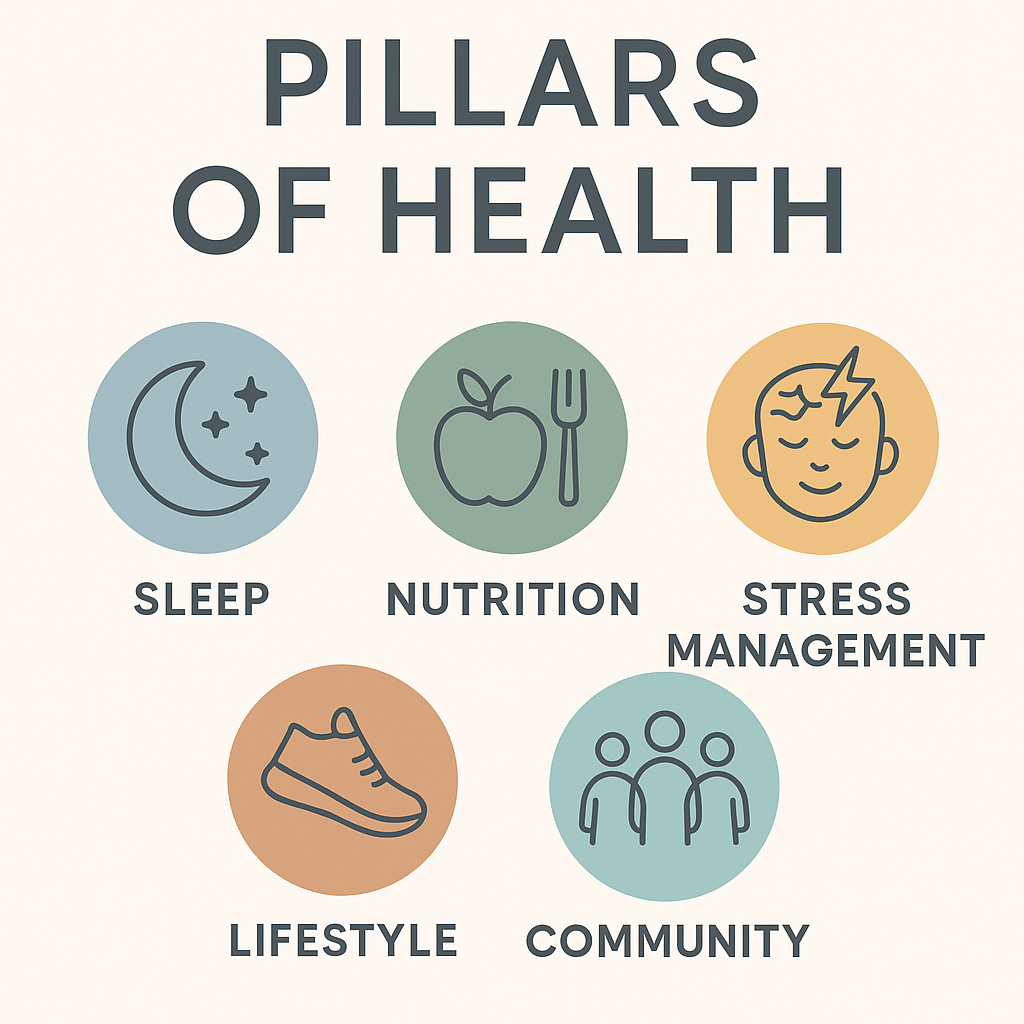
The Five Pillars of Health and Why They Matter

This is a core philosophy of mine: 90+% of people’s health needs can be improved—or even resolved—by addressing and balancing what I call the pillars of health.

So what are they?

  • Sleep
  • Nutrition
  • Lifestyle
  • Stress Management
  • Community

From one health professional to another, the language may vary—some might add or group things differently—but you’ll find versions of this framework across many holistic and integrative practices. These five pillars are, in my professional opinion, the foundation of a long-term health plan. They’re also the best place to start when working through chronic conditions, before jumping straight to complex protocols or exotic supplements.

Each of these deserves a deeper dive (and they’ll each get one in future blog posts), but let’s introduce them briefly:


Sleep
Sleep is non-negotiable. It’s when your body and brain repair, reset, and regenerate. Chronic sleep issues are linked to everything from mood disorders to blood sugar imbalances. The best keyword to search if you’re having trouble? Sleep hygiene. You’ll find plenty of science-backed strategies to help troubleshoot and improve your sleep quality.


Nutrition
You are what you eat—quite literally. Every cell in your body is made from the food you consume. (Fun fact: most cells in the human body are replaced every 7 to 10 years.) While there’s no universal “perfect diet,” some principles are nearly universal: nutrition matters, overeating is a common contributor to chronic disease, and whole foods generally beat food products in every way.


Lifestyle
How you live—how you move, rest, and spend your time—has a powerful impact on health. I know I feel my best when I’ve exercised regularly and spent time outdoors, and the research backs that up. Movement and nature both reduce inflammation, boost mood, and support immune function. A healthy lifestyle isn’t a single habit—it’s the rhythm of your daily choices.


Stress Management
Modern life runs fast—and it shows up in the body. Chronic stress increases the risk of nearly every major health issue, and often disrupts other pillars like sleep and dietary choices. Whether it’s breathwork, therapy, walks in the woods, or setting better boundaries, finding your way to manage stress is essential, not optional.


Community
This one surprises people—but it’s vital. A sense of connection and belonging isn’t just emotionally nourishing; it’s physiologically protective. Studies on centenarian “Blue Zone” populations show that tight-knit communities correlate strongly with longevity and life satisfaction. In the often-isolating landscape of modern American life, rebuilding community is real health work.


Why Pillars?
They’re called pillars because they support one another. When you’re consistently tending to even one area of your health, you often feel better—and that momentum makes it easier to show up for yourself in other ways too. For example, regular exercise—a lifestyle choice—can significantly reduce stress. And with less stress, it becomes easier to sleep well, make nourishing food choices, and engage with community. It’s all connected.


Final Note
To be clear: there are specific conditions that need specific interventions. Antibiotics have their place. Supplements and pharmaceuticals can be crucial tools. And yes, sometimes you might just need vitamin C because you’ve unknowingly been living the life of a pirate. But for most people, most of the time, real, lasting health begins by tending to these five pillars.

Stay tuned—I’ll be exploring each of these pillars in more depth in upcoming posts.