Treatment Ideology

Hello everyone!

It has been a little while since I’ve posted. On the one hand I just didn’t have any more frequently asked questions on the top of my mind. And I’ve been spending my creative writing energies on posts to my personal social media instead of this work blog.

That said, I’m thinking some of the things I post on my personal accounts might be relevant here. Mainly these spiritual-psychological principles I feel are at the core of healing/growth. These perspectives are at the heart of my practice, so lets discuss them.

The following are a list of ideals I have for my practice. Which is to say they’re what I’m striving towards, not necessarily what I can always live up to.

Meet the patient where they’re at.

    What this means to me is that I’m not expecting everyone to be a nutritionist, yoga teacher, or ready to make massive lifestyle changes tomorrow. It’s important that people know that they’re accepted first and foremost wherever they’re at in their healing journey and we can make some positive nudges if/when folks are ready.

    Adapt to their needs

    Very similar to the first, I really want to make space for patients to get the experience they’re looking for. While it is true I’m the one that went to school for this stuff, I think its just as important to recognize the innate wisdom in having lived your own life. If, for example, your nervous system feels a lot better chatting for half the treatment, most of the time I think that’s exactly what we should do. Conversely, I seek to frequently create spaces where we can fall into a comfortable silence as that often seems helpful.

    Lets go at the pace of your nervous system

    This is one I harp on a lot in practice. While there’s certainly work to do physically or energetically through massage/acupuncture, establishing a sense of safety in your nervous system is my priority. I honestly have a challenging time when patients seem to be asking me to override their nervous system, wanting harder/more intense treatments than I think are ideal. In this case I often try to find a new balance between the request (adapting to where they’re at) and my sense that a gentler approach would be more effective.

    Let’s practice listening to your body

    While there are plenty of times I’ll use my knowledge of the body to translate for example back pain into a potential hip-origin, or translate leg pain into sciatic nerve pain, very often its helpful to work exactly where the nervous system is pointing. There’s a lot of wisdom inherent to how our systems are set up, so listening to those cues, many patients can tell me when something feels like “exactly what I need” or “a good kind of pain”. Similarly, if someone notices they’re guarding or feeling more tense because of what I’m doing, I want to hear that feedback so we can find a new avenue of approach.

    Overall

    Zooming out almost entirely, I believe the core of life is loving awareness. Ultimately each of us is responsible for bringing loving awareness to ourselves. But when I’m working, I practice extending that loving awareness to another individual.

    To be clear, this “love” is the type known as Metta in Pali, which translates to “loving-kindness,” “benevolence,” or “friendliness”.

    I think this combination of witnessing and accepting is at the core of the healing process. And I think practicing giving metta to ourselves helps us give it to others and practicing giving metta to others helps us give it to ourselves.

    That said,

    I didn’t go to school for nothing. There’s still specific points and techniques I’m performing each visit. I look to assess your needs and provide the best treatment I know how, drawing on my knowledge and experience. And this really is good news because it means even if I’m having a rough day, the acupuncture points and massage techniques do have their own distinct effects. Thankfully, treatment outcomes ultimately do not depend on me having perfect vibes with every patient every day. Sometimes the best I can do is just let the practice speak for itself.

    Bonus

    Just wanted to share that while I’ve used ChatGPT to help fill out the majority of my blog posts, this one is AI-free. So the formatting a readability takes a bit of a hit, but I am happy to share that this one is straight from my heart to the keyboard to you.
    On a Personal Note

    Hello there! I’ve been focusing on keeping this blog limited to clinically relevant information, my advice and perspective around healing. This bit below isn’t entirely opposite of that, but the original purpose of the words was fulfilling my desire to share a bit about myself on my social media accounts.

    Still, I think it can be helpful sometimes to know who you’ll be talking to in a session, assuming you don’t just start snoozing! I do my best to translate my perspective to fit whoever I’m working with, but the bits below are closest to my unfiltered perspective on people and life.

    If you don’t know the folks in the first line, feel free to look them up, both have a pretty strong online presence, and a lot of good talks & writing. Without further ado:


    I think my perspective on life is 50% Alain de Botton, and 50% Ram Dass. Half psychology, and half spiritual.

    The former essentially says we’re each individually kind of a mess and that’s okay. The latter saying essentially that we’re unified ultimately by an infinitely wise and loving Oneness.

    I think either perspective might be hard to take on depending on the person. Of the two I think the psychology is easier to argue, certainly easier to study and prove that we all have various neuroses and coping mechanisms we pick up. We all have our aspects of enduring immaturity and ridiculousness, and yet somehow we muddle through. I think many people make the mistake of thinking they’re uniquely messed up when I think the awareness and willingness to continue to work on oneself is the unique part, not the wounds.

    The spiritual side is one I’ve long struggled internally to argue. And I’ve concluded, it’s not something meant for debate. I don’t think there’s any particular words that can beat out a single heart breaking story of life’s horrendously challenging ways.

    I think it’s experiences of loss, prayer, meditation, psychedelics, various ways people come to actually touch and connect with this universal Love that changes people in ways that words just can’t adequately convey.

    And in that way psychology and spirituality are similar: people have to find the humility to choose to try something different. Usually it’s through significant hardship that people really put in the work to second guess their own viewpoint of the world. And despite however much good intention exists, no one can do that work for someone else.

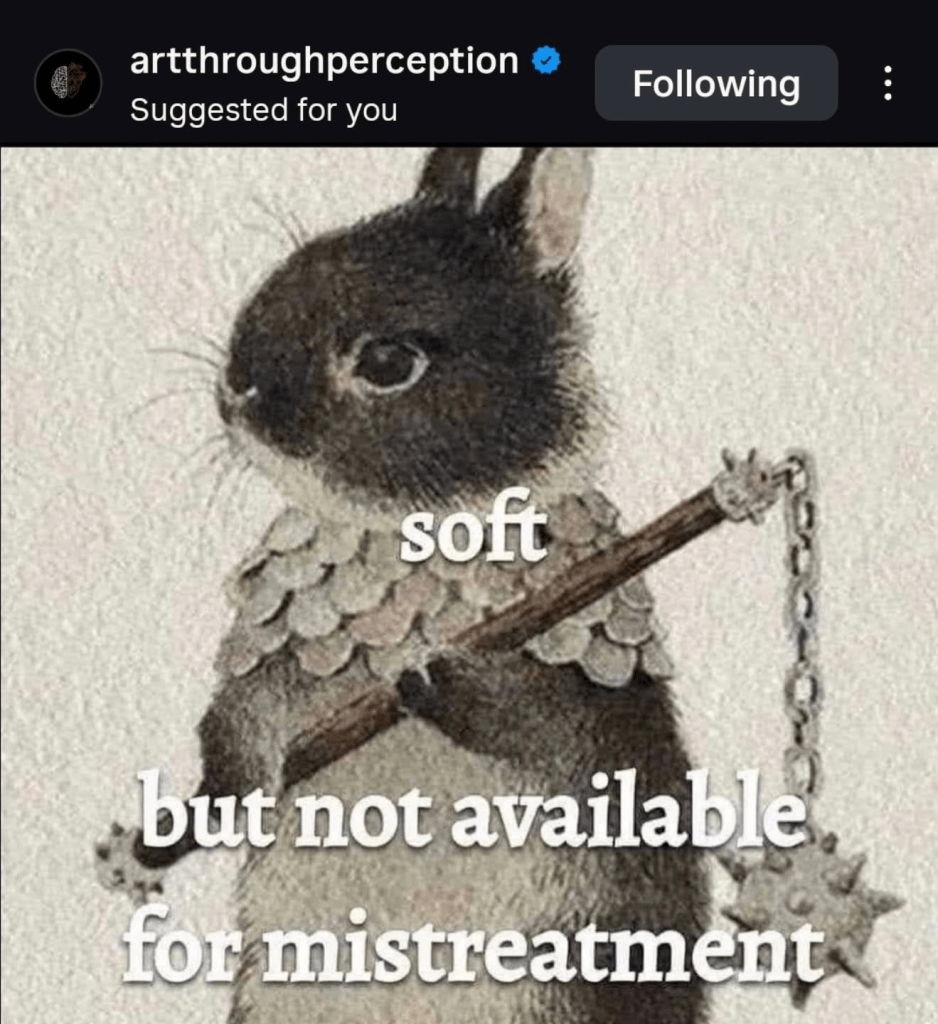
    I really like this rabbit, to me it symbolizes vulnerability and boundaries. The capacity to love one’s self enough to protect yourself.

    I think its helpful to acknowledge both, that we’re so foundationally all in this together and that life can be confusing and scary and cause people to act unkind and harmful out of ignorance and fear.

    So, here’s to all of us, here’s to being kind and loving to ourselves and each other. And to this badass rabbit with a morning star flail thingie. 

    All Are Welcome Here: A Safe Space for LGBTQ+ Clients

    “Be grateful for whoever comes,
    because each has been sent
    as a guide from beyond.”

    —Rumi, The Guest House

    I’ve been surprised—and honestly, really touched—to hear how many of my new patients say they’ve read my blog posts. It makes me happy to know I can start connecting and helping even before someone walks through the door.

    I can be a fairly introverted guy myself, and I get how reassuring it is to get a feel for the person you’ll be trusting with your care before ever stepping into the room.

    That’s especially true for folks in the LGBTQ+ community. Nearly everyone I’ve met from that community has, in some way, experienced moments of unsafety and bias. So it makes sense that there’s an extra layer of challenge when taking that vulnerable first step toward care.

    It might seem like a surprising connection, but many of the veterans I work with have confided in me that they’ve felt pre-judged as well. They’ve felt like people were responding more to preconceived notions of a veteran—or to their tattoos, or something surface-level rather than seeing them for who they really are as people.

    I’m tearing up just writing this because I think in regards to either community, its a really important part of the work that I try to do. I want to always seek to set aside my own potential biases, my own knee-jerk reactions, and instead be present with and get to know whoever shows up to my practice.

    As a healer, that matters. It matters that I take the time to understand and really connect with each person that comes in. It matters that I come to understand the context of their lives rather than simply focus on their diagnosis. While I’m not a licensed therapist (and I’m always transparent about that), I do believe that emotional safety is as essential to healing as physical safety.

    I’m not perfect, but I take this safety as a sacred duty. Every person who comes into my practice deserves to be cared for as a whole person, and if nothing else, I do my best to make space for whatever that entails.

    If you’ve ever felt nervous about trying acupuncture, massage, or just showing up somewhere new, I hope this helps. I promise that, whoever you are, I’ll do my best to meet you with patience, presence, and care. Everyone is welcome.

    Community, Solitude, and Health: A More Nuanced View

    “Solitude can be enriching or impoverishing. Its impact on well-being depends critically on the degree of choice, personal comfort with aloneness, and ability to self-regulate emotions.”
    Thomas NK, Azmitia M. Psychological Benefits of Solitude: Perspectives from Social and Personality Psychology. PSPR. 2018.

    “Negative social relationships predict increased inflammation and poorer health outcomes, sometimes more so than a lack of social relationships.”
    Uchino BN, Social Support and Health: A Review of Physiological Processes. Health Psychol. 2006.

    When the idea of Blue Zones was introduced to the public in 2008, it was something of a revelation. The notion that tight-knit community life could be directly tied to longevity felt both intuitive and groundbreaking. Across these pockets of the world where people routinely live past 100, strong social bonds weren’t just a pleasant feature — they seemed to be a key part of the longevity formula.

    Since then, the idea has spread, but often in reverse: we now hear more about loneliness and its connection to poor health outcomes. Unfortunately, much of the popular conversation has drifted into oversimplification. One of the most popular headlines that’s emerged from this research is the claim that loneliness is as bad for your health as smoking 15 cigarettes a day.

    The comparison comes from the rough equivalence between two separate findings:

    • According to a 2010 meta-analysis, strong social relationships are linked to a roughly 50% lower risk of all-cause mortality.
    • Smoking 15 cigarettes a day is associated with about a 50% increase in mortality risk.

    Superficially, these numbers look similar — but they aren’t logically interchangeable. This kind of equivalence ignores the massive individual variability in both smoking outcomes and the experience of social connection. It makes for an alarming slogan, not a nuanced understanding.

    Worse, the framing itself can be psychologically harmful. Imagine telling someone who is already struggling with isolation or loss that their loneliness is now actively destroying their health and doing so as badly as a pack-a-day habit. Rather than helping, this can compound shame and helplessness, making the path toward connection feel even heavier.

    The deeper truth is this: it’s not simply how many people surround you, or whether you are in a relationship, that drives well-being. It’s the quality of the relationships you maintain — and even more so, your inner relationship with yourself. A life filled with superficial or draining connections can be as stressful as isolation. Meanwhile, peaceful solitude and a calm, integrated state of mind can support health in profound ways. It is not the absence of company, but the presence of distressing loneliness that carries risk.

    This is what I was alluding to by opening an article on community with two pro-solitude research quotes: mindset matters. As much as it might surprise those still holding to an outdated “body as machine” paradigm, there is now a wealth of evidence showing that how we feel — our emotional landscape, our sense of ease or distress — directly influences health outcomes. For many, social connection is a vital source of positive emotion and physiological support. But it’s important to note that introverts aren’t quietly dying off, either. In fact, one of the most life-affirming relationships we can cultivate is the one we have with ourselves.

    Ultimately, the research is clear: both connection with others and peace within oneself can support better health. It’s not about chasing a specific number of relationships or fearing time alone — it’s about fostering the kinds of relationships, internal and external, that help your nervous system settle into safety and ease.