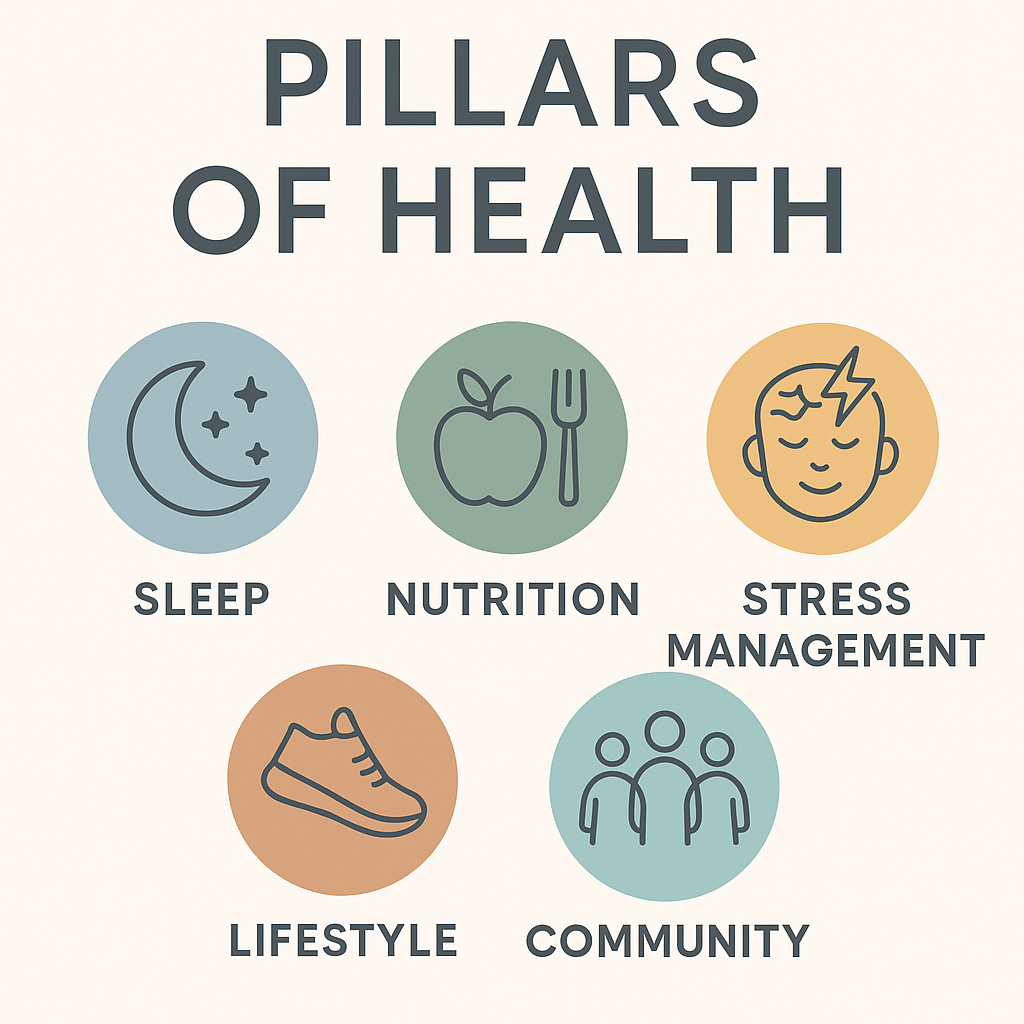
The Five Pillars of Health and Why They Matter

This is a core philosophy of mine: 90+% of people’s health needs can be improved—or even resolved—by addressing and balancing what I call the pillars of health.

So what are they?

  • Sleep
  • Nutrition
  • Lifestyle
  • Stress Management
  • Community

From one health professional to another, the language may vary—some might add or group things differently—but you’ll find versions of this framework across many holistic and integrative practices. These five pillars are, in my professional opinion, the foundation of a long-term health plan. They’re also the best place to start when working through chronic conditions, before jumping straight to complex protocols or exotic supplements.

Each of these deserves a deeper dive (and they’ll each get one in future blog posts), but let’s introduce them briefly:


Sleep
Sleep is non-negotiable. It’s when your body and brain repair, reset, and regenerate. Chronic sleep issues are linked to everything from mood disorders to blood sugar imbalances. The best keyword to search if you’re having trouble? Sleep hygiene. You’ll find plenty of science-backed strategies to help troubleshoot and improve your sleep quality.


Nutrition
You are what you eat—quite literally. Every cell in your body is made from the food you consume. (Fun fact: most cells in the human body are replaced every 7 to 10 years.) While there’s no universal “perfect diet,” some principles are nearly universal: nutrition matters, overeating is a common contributor to chronic disease, and whole foods generally beat food products in every way.


Lifestyle
How you live—how you move, rest, and spend your time—has a powerful impact on health. I know I feel my best when I’ve exercised regularly and spent time outdoors, and the research backs that up. Movement and nature both reduce inflammation, boost mood, and support immune function. A healthy lifestyle isn’t a single habit—it’s the rhythm of your daily choices.


Stress Management
Modern life runs fast—and it shows up in the body. Chronic stress increases the risk of nearly every major health issue, and often disrupts other pillars like sleep and dietary choices. Whether it’s breathwork, therapy, walks in the woods, or setting better boundaries, finding your way to manage stress is essential, not optional.


Community
This one surprises people—but it’s vital. A sense of connection and belonging isn’t just emotionally nourishing; it’s physiologically protective. Studies on centenarian “Blue Zone” populations show that tight-knit communities correlate strongly with longevity and life satisfaction. In the often-isolating landscape of modern American life, rebuilding community is real health work.


Why Pillars?
They’re called pillars because they support one another. When you’re consistently tending to even one area of your health, you often feel better—and that momentum makes it easier to show up for yourself in other ways too. For example, regular exercise—a lifestyle choice—can significantly reduce stress. And with less stress, it becomes easier to sleep well, make nourishing food choices, and engage with community. It’s all connected.


Final Note
To be clear: there are specific conditions that need specific interventions. Antibiotics have their place. Supplements and pharmaceuticals can be crucial tools. And yes, sometimes you might just need vitamin C because you’ve unknowingly been living the life of a pirate. But for most people, most of the time, real, lasting health begins by tending to these five pillars.

Stay tuned—I’ll be exploring each of these pillars in more depth in upcoming posts.

Meditation 101

Often, meditation is something my patients say they’ve tried but that “didn’t work” for them. I usually respond with this thought exercise:

Let’s say you lived in a world without Spotify, radios, or any easily accessible music. In this imaginary hellscape, you only have a violin, which you’ve never played before. You might pick up the violin specifically when you want to hear music, but unfortunately, your first experiences won’t be sweet, melodic sounds — just a screechy mess.

I think this is why meditation can turn so many people off. Meditation, in essence, runs counter to our very nature. It’s entirely natural to want to problem-solve, to have the “monkey mind,” as the Buddhist texts call it. We constantly seek something to keep us interested — even if that thing is our own discomfort, something upsetting a friend told us recently, or getting cut off in traffic. In a funny way, even these more “negative” thoughts can feel more natural than just noticing the breath.

But with practice, the music improves. Whether you’ve read some of the many research papers on the benefits of meditation, or just heard a friend say it helped her sleep, something keeps you coming back. You push past the initial discomfort and start to build a habit.

Lo and behold, those discordant sounds — the uncomfortable thoughts made louder by the silence — finally give way to moments of real calm. The practice of setting down whatever mental object arises and returning to the breath gradually allows your soul, mind, and nervous system to find ease for longer and longer stretches of time.

Over time, meditation becomes a great tool for self-regulation — a practice that helps you simply be with yourself, without the constant push and pull of craving and aversion.

Five to ten minutes each evening before bed is a great place to start, and has been shown to improve sleep quality.

To start meditating, find a comfortable seat — ideally upright on a small cushion, or in a chair with your spine tall and the crown of your head gently reaching toward the sky. Begin breathing naturally, and notice the sensation of your breath. At first, it might be helpful to count each breath: [Inhale] 1, [Exhale] 2, [Inhale] 3, etc., up to 10, then start over at 1.

Possibly the most important part of the practice is the very moment you notice you’ve been distracted. You realize you’ve been thinking about work for the last five minutes. Don’t fret, don’t chastise yourself, and don’t rush off to write down what you were thinking. Ideally, the moment you realize you’ve drifted, you simply come back to the breath.

If you find yourself getting distracted a lot, congratulations — you’re human. I genuinely don’t think the process needs to be any different for someone with full-on ADHD versus someone without. Like any other practice, it might take more time for one person than another, but the basic process is the same for everyone. Everyone will find stumbling blocks when learning to meditate. The important thing is not to let those challenges grow into their own story.

If needed, remind yourself that meditation time — like violin practice time — isn’t the time for ruminating on why you aren’t a natural savant. If you really want to, you can spend the rest of the day contemplating whether meditation “just isn’t for you,” but during your practice time, simply practice. Save the self-criticism for later.

In the end, unlike the music metaphor, meditation really is something only you can do for yourself. You really are the only person who can always be there for yourself, hear all your own thoughts — and you get to decide how to shape your inner landscape.

There are many other kinds of meditation. Another favorite of mine is a body-scanning practice called Vipassana. There’s also loving-kindness meditation, which focuses on cultivating positive emotions rather than bare awareness of sensation. And there are many others to explore.

If you’re interested in learning more about meditation, there are tons of great resources online, as well as many local meditation centers. And I’m always happy to talk more with any patient who’d like to dive deeper.

The Basics of Physical Therapy: What I Tell My Patients Most Often

Disclaimer: With this and any other blog post, please note that nothing written here is a substitute for getting specifically tailored advice from a specialist/provider.

Much of the physical therapy information I share with patients comes from Dr. Aaron Horschig of SquatUniversity.com. While the information is geared towards lifters, I find his information to be well researched and widely applicable.

The main idea is that pain often comes down to mobility and stability issues that can be corrected over time with consistent use of proper stretches and stabilization exercises.

While specific evaluation of a patient is necessary to gear a treatment plan for someone, there are some broadly applicable themes for most cases.

Let’s look at the shoulder for instance. Stiffness and tightness around the shoulders might be due to stuck or spasmed muscles around the shoulder such as the trapezius (trap) or latissimus dorsi muscles (lats). Alternatively, you might be dealing with the very common issue of under-trained or underactive rotator cuff muscles, which are meant to stabilize the shoulder joint.

It’s entirely possible to have both going on at once. If so you might practice different mobility/stretching work for the shoulders first, or even a foam roller lat release. Then after your body is moving properly, you might practice some kind of external rotation stabilization exercise at the shoulder, making sure to pause for at least 5 seconds at the most challenging part of the movement.

Essentially certain prime movers/big muscles can often overpower our smaller stabilizer muscles.

So first we work to loosen up these overpowering muscles before getting the stabilizers to do the job they were meant for. It’s important to note that pure strength of the stabilizers is not the goal. We need the body to get into this subconscious habit of turning on the stabilizers when we move, not to just contract them strongly with specific exercises, and be ignored otherwise.

Often the progress is a combination of fast and slow. It’s fast because when you get the right combination of exercises, and properly mobilize and stabilize the shoulder joint, you can do relatively light weight pain-free movement immediately in some cases. However, the pain will likely return automatically without consistent effort to retrain the body into this new mode of movement.

Another common painful area that can respond well to physical therapy is the lower back. However, the lower back can be more complex to evaluate and treat. The root of the problem might originate all the way down at the foot—or anywhere in between, especially the ankles, knees, or hips.

The overall principles are the same though: evaluate which areas aren’t moving properly, and then what stabilizer muscles aren’t activating properly, loosen/move the former and train the latter, usually in a more static movement-resisting fashion.

There are a couple different options for making this information more specific to you. Squatuniversity.com has a ton of videos all over the internet you can search for that go over specific problem areas, so that’s an easy way to get started looking into your own challenges. You can always work directly with a physical therapist on these issues. I’m also happy to point you in the right direction during our sessions.

Feel free to send me a text at 919-809-9355 to get started.