Dry Needling

Probably one of the most common questions I get asked is: What do you think of dry needling? Or do you provide dry needling?

It’s a complicated thing to answer because I think there are two valid ways to see it.

The Legal & Scope-of-Practice Angle

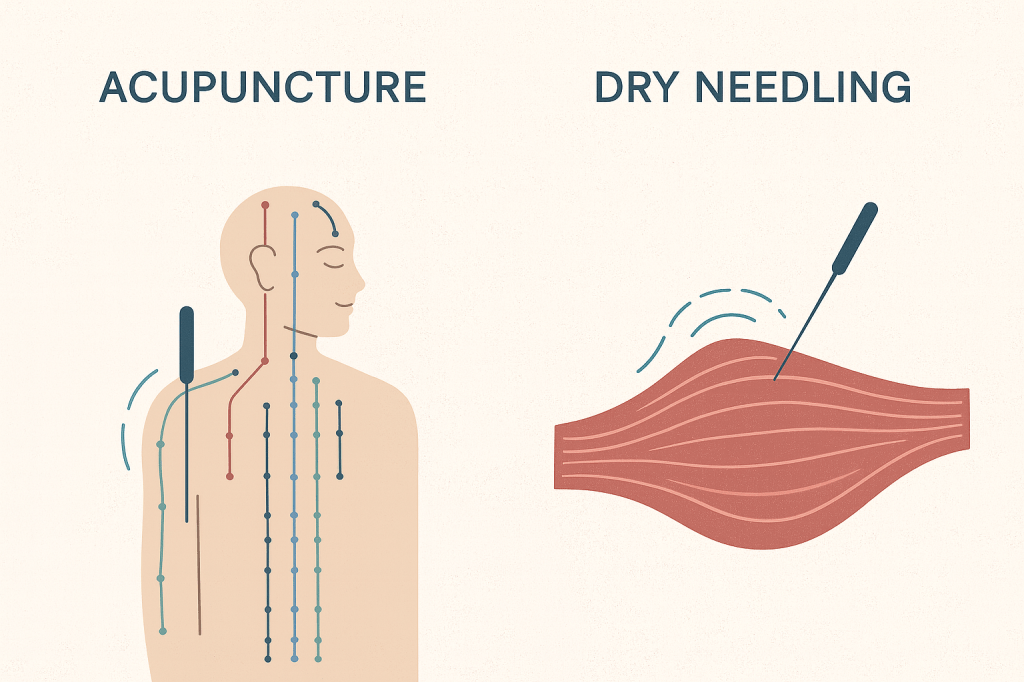
As of writing, dry needling is illegal in California, Hawaii, New York, Oregon, and Washington. The essential issue is this: I don’t take a weekend course in chiropractic adjustments and call myself a “dry chiropractor” or “holistic joint manipulator” or something of the sort.

The primary argument against dry needling, as I understand it, is that the requirements for training aren’t stringent enough to ensure safe and effective treatment. Acupuncture licensure includes extensive training for years to make sure we can insert needles into people in ways that are consistently safe and beneficial.

There’s also the financial reality: it’s an encroachment on scope of practice that acupuncturists mostly deal with because they’re under-represented in a lobbying sense in most states.

But That’s Not the Whole Story

All that said, I don’t think the legal debate tells the full truth. I believe it is possible for a physical therapist or chiropractor to put in the time and effort to genuinely perform dry needling in a way that is safe and helpful.

In my clinical opinion, there is something beneficial about specifically targeting muscle tension through trigger points or neuromuscular junctions—without necessarily needing to interpret the more subtle energetic connections that traditional acupuncture focuses on.

Some acupuncturists even take dry needling classes for this reason: to supplement their traditional training with a more Western, physiology-based approach to the body, especially around trigger points and fascial connections. Traditional acupuncture is deeply enmeshed in Chinese herbal theory and an extremely detailed mapping of the energetic body. It’s rich—but it can also be overwhelming when sometimes you just want to get a spasmed muscle to relax.

Do I Do Dry Needling?

When people ask if I do dry needling, I say yes. I’m more than capable of palpating trigger points and treating them. I mainly let people know that I use a more subtle, gentle technique than most dry needlers. I say this based on both my own experience receiving dry needling and the experiences patients share with me.

Dry needling techniques can often be overly aggressive and, at times, can feel re-traumatizing rather than creating a consistently positive healing experience.

My Main Gripe: The “No Pain, No Gain” Mindset

Assuming someone doing dry needling is being safe about it, my real issue is that the intensity of the technique sometimes scares people away from acupuncture altogether. I’ve had many patients tell me they were afraid to try acupuncture because of a previous dry needling experience.

So then I have to educate: while acupuncture can come with some sensation, the intensity is much lower, and many patients feel little to nothing during an effective treatment. It is possible to resolve pain without causing pain.

Where I Land

So that’s my opinion overall. If I had to pick a side, I prefer a generous approach. I’d love to share this practice, and ideally more people would have access to safe, effective treatments to reduce pain.

I’d prefer more training and a shift in perspective—one that considers the nervous system as much as the tissue—so as to avoid treatments that feel like re-injury. But if pressed, I wouldn’t reduce access to acupuncture or to its relatively new Western spin-off: dry needling.

More Than Relaxation: How Massage Supports Whole-Body Health

Most people know massage feels good. What fewer realize—especially here in the U.S.—is how much real, measurable benefit it can have on your health. In places like Norway or much of Western Europe, massage is often seen as a regular part of staying well, not just an occasional treat. But in America, it’s still mostly viewed as a luxury or indulgence. The reality? Massage can help with chronic pain, poor sleep, anxiety, and even immune function. If you’ve ever walked away from a session feeling clearer, calmer, or more at home in your body, that wasn’t just in your head. There’s solid research behind those effects—and for a lot of people, massage is more than relaxation. It’s part of how they stay healthy.


1. Reduces Stress and Lowers Cortisol
Massage therapy has been shown to significantly reduce cortisol levels and increase serotonin and dopamine.

[Field, 2005 – Int J Neurosci]
[Rapaport et al., 2010 – J Altern Complement Med]

2. Alleviates Muscle Tension and Improves Range of Motion
Regular massage decreases muscle stiffness and improves joint flexibility, supporting athletic recovery and injury prevention.

[Weerapong et al., 2005 – Sports Med]

3. Improves Sleep Quality
Massage has been shown to improve both the depth and duration of sleep, including an increase in delta wave activity—the kind linked to deep, restorative rest.

[Richards et al., 2000 – J Clin Rheumatol]
[Field et al., 1998 – Early Hum Dev]

4. Reduces Pain—Both Acute and Chronic
Massage can reduce chronic low back pain, neck pain, fibromyalgia symptoms, and postoperative pain.

[Furlan et al., 2008 – Cochrane Review]
[Moyer et al., 2004 – Pain Med]

5. Supports Mental Health: Anxiety & Depression
Massage therapy can reduce symptoms of anxiety and depression, likely via nervous system regulation and oxytocin release.

[Moyer et al., 2004 – Psychol Bull]
[Field et al., 1996 – Int J Neurosci]

6. Boosts Immune Function
Massage may enhance immune markers like natural killer cells and lymphocyte count—particularly helpful in people under stress.

[Field et al., 2005 – J Altern Complement Med]


Final Thoughts
Whether you’re in pain, managing stress, or simply trying to stay well, massage therapy can be a valuable part of your routine. For anyone looking to prioritize feeling better, massage is a surprisingly prudent choice as a regular therapy.

From Needle to Nervous System: How Acupuncture Reduces Pain

I really enjoyed working on this post—it’s been a while since I sat down and revisited all the specific ways acupuncture helps the body heal. One of my first thoughts was:
“Oh! Look at all these great things I do at work each day. Nice!”

In the clinic, I usually keep things broad when explaining how acupuncture works. That’s partly to keep it relatable for my patients, but if I’m honest, sometimes I also forget the specifics—I’m focused on the work itself, not the mechanisms underneath.

Before we get into what the research says, I want to share a metaphor I often use to explain how acupuncture helps reduce pain.


🏋️‍♂️ Acupuncture as Exercise

Strength training is a hobby of mine, and so I’ve learned that when you do a bicep curl, you’re not immediately growing your biceps brachii muscle. You’re causing micro-tears, triggering a release of endorphins, and setting off a healing cascade: increased circulation, immune activation, growth hormone, tissue repair. Most of that “magic” happens later—especially during sleep—when the body adapts to the stress you just gave it.

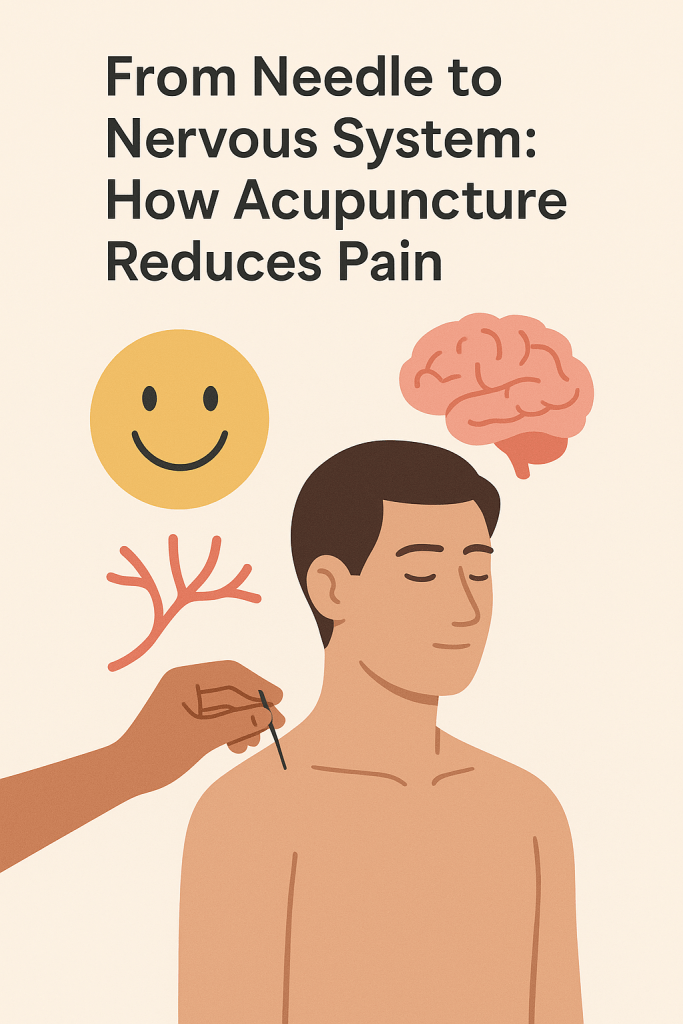
Acupuncture works similarly. When a needle enters the tissue, it’s a gentle, targeted disruption—a stimulus that the body responds to with a series of healing actions. As you’ll see below, that response includes everything from increased blood flow to reduced inflammation to the release of your own natural painkillers.

So what we’re doing is twofold:

  • Immediate relief – Downregulating pain signaling in the nervous system.
  • Long-term healing – Supporting circulation, reducing inflammation, and easing tension so real progress can happen over time.

Acupuncture can support many different conditions, but for today—and for the primary focus of my clinic—we’re talking pain.


📊 Summary: How Acupuncture Helps Reduce Pain

EffectMechanismWhat Research Shows
⬆️ Local blood flowVasodilation via neuropeptides (like CGRP, Substance P) and nitric oxideIncreased circulation at needled sites; enhanced healing response
🌿 Muscle/fascia releaseMechanical stimulation of connective tissue and myofascial modulationNeedles create local tissue stretch and relaxation, reducing muscle tone and tightness
😊 Pain reliefRelease of endogenous opioids (endorphins, enkephalins, etc.)Natural painkillers released; pain pathways inhibited in brain and spinal cord
🔥 Inflammation reductionSuppression of pro-inflammatory cytokines; immune system modulationLower levels of IL-6, TNF-α, and other inflammatory markers after acupuncture
🧠 Nervous system shiftActivation of parasympathetic system; modulation of brain pain perceptionChanges in limbic system and somatosensory cortex; improved nerve conduction (e.g., CTS)

🧠 Digging Into the Research

1. Nerve Stimulation & Circulation

Inserting a needle activates local sensory nerves, triggering neuropeptide release (e.g., Substance P, CGRP), which leads to vasodilation and increased blood flow around the point.
At the Zusanli point (ST36), stimulation increases cerebral blood flow via nitric‑oxide–mediated vasodilation and reduces inflammatory markers like IL‑6.

2. Muscle Relaxation & Connective Tissue Response

Research indicates that needle insertion mechanically deforms tissues—including fascia—which may relax tight muscle fibers and reset tension via connective‑tissue modulation.

3. Endorphin & Opioid Peptide Release

Acupuncture—especially electro-acupuncture—stimulates the release of endogenous opioids like enkephalins, β‑endorphin, endomorphin, and dynorphin. Different stimulation frequencies affect which peptides are released. These peptides block pain signals in both the central and peripheral nervous systems, similar to morphine, but naturally produced by your body.

4. Anti-Inflammatory Effects

Acupuncture exerts strong anti-inflammatory effects by reducing cytokine release, suppressing inflammatory cell activity, and recruiting neutrophils that help resolve local inflammation.
In stroke patients, it has even been shown to improve neurological recovery by dampening inflammatory processes.

5. Modulation of Pain Signal Processing

There’s evidence that acupuncture inhibits hyperactive pain pathways: reducing activity in pain-related ion channels, suppressing glial cell activation, and stimulating descending inhibitory systems that release serotonin, norepinephrine, and opioid peptides.
In carpal tunnel syndrome, real acupuncture (especially electro-acu) improved nerve conduction and triggered cortical brain remodeling—while sham acupuncture yielded only temporary symptom relief.


🧾 Conclusion

The World Health Organization (WHO) has recognized acupuncture as a potentially effective treatment for over 100 conditions—ranging from migraines and digestive issues to anxiety, allergies, and infertility. Each of those conditions involves its own unique physiological patterns, and in each case acupuncture works through a wide range of mechanisms to support the body’s return to balance.

For today though, addressing some of the ways in which acupuncture helps with pain seems like plenty—both by calming the nervous system and by supporting long-term healing where the body needs it most.