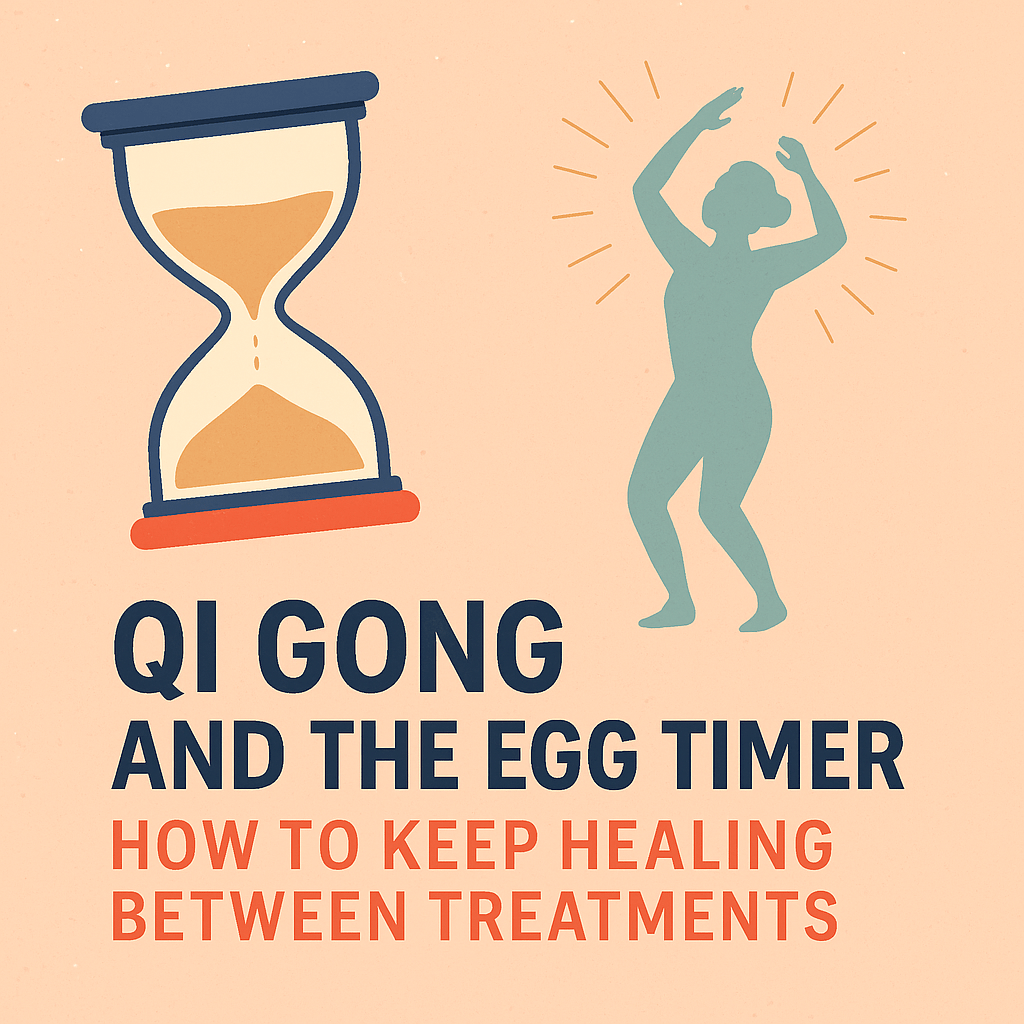
Qi Gong and the Egg Timer: How to Keep Healing Between Treatments

“As long as you are awake, you can be mindful.
All it takes is wanting to and remembering
to bring your attention into the present moment.”

— Jon Kabat-Zinn


So you’re getting regular bodywork… but the aches keep coming back?

The problem isn’t you. The problem is the economy. More specifically: hours hunched over a desk, eyes locked on a screen, posture slowly folding in on itself.

Even with good treatments, your body is up against a daily tide of stress, static positions and repetitive movement. Both our body and our mind calcify into the same painful patterns unless we consistently make intentional efforts to shift them.


Enter: the hourly reset

I often suggest patients set a simple alarm every hour. When it goes off, it’s your cue to:

  • Best: Get up, walk around, shake it out.
  • Good: Take 1–3 deep, conscious breaths before diving back in.
  • At least: Notice your body. Are your shoulders creeping up toward your ears? How’s your neck doing?

Qi Gong shaking (a favorite)

Qi Gong has a simple, joyful reset:

  1. Rise up on your toes.
  2. Drop down and let your whole body shake.
  3. Add sound if you want—hum, sigh, or let out whatever noise you want!

It’s about moving energy, loosening tension, and resetting your nervous system.

Alternatively, just put on a song and dance it out.


Why it matters

Your body and nervous system both need regular resets, especially if you’re doing stressful or intense work. These micro-pauses are huge for shifting the pattern of stress solidifying into recalcitrant habits of tension. Without body mindfulness and consistent movement, even the best therapeutic treatment is just a temporary fix.


Conclusion

If you’re investing in regular treatments but not feeling lasting progress, don’t give up. Try adding micro-resets: mindful movement, a shake, or even just one intentional breath each hour.

Because mindfulness is magic and movement is medicine.

Hip Airplane: Stop Letting Your Back Do Your Hips’ Job

What It Is

  • Category: Dynamic stability + active mobility drill
  • Focus: Strengthens glute medius/max, deep hip rotators, and core while actively improving hip internal/external rotation range.
  • Why It Works: You’re balancing on one leg, hinging forward at the hips, and then rotating your pelvis open/closed—forcing the stabilizers to work while moving through controlled ranges.

Why It’s Great for Stability + Mobility

  • Stability: Trains the glute medius to hold the pelvis level while dynamic movement happens above.
  • Mobility: Opens and closes the hip capsule actively, increasing usable rotation range (critical for deep squats, lunges, kicking, and acro).
  • Balance: Challenges proprioception
  • Core–hip connection: Forces the obliques, core and back muscles to stabilize the spine while the pelvis rotates.

How to Do Hip Airplanes

1️⃣ Setup

  • Stand tall on one leg (soft bend in knee).
  • Hinge forward from the hips into a single-leg RDL position — back leg extended behind you, torso roughly parallel to the ground.
  • Arms can go out like airplane wings for balance, or hands on hips to feel your pelvic rotation.

2️⃣ Movement

  • Open: Slowly rotate your chest and pelvis outward, so your hips are “stacked” (standing leg hip moving into external rotation).
  • Close: Rotate your chest and pelvis inward, so your hips are “square” or even slightly past square (standing leg hip moving into internal rotation).
  • Keep the knee of your standing leg pointing forward—don’t let it drift side to side.
  • Move with control, pausing briefly in each position.

3️⃣ Reps & Tempo

  • 3–5 reps per side, each rep being open → closed → back to open = 1
  • Slow and controlled: ~3–5 seconds each way

Key Cues

  • Hinge, don’t twist the spine → all the rotation happens at the hip socket.
  • Standing leg stays strong → slight bend, knee over mid-foot.
  • Foot tripod → big toe, little toe, and heel stay grounded.
  • Think of “rotating your belly button” rather than swinging the leg.

Link to Back and Hip Pain

Back pain

  • Limited hip rotation or poor pelvic stability forces the lumbar spine to rotate more than it should, creating micro-twists with every step or bend.
  • Hip airplanes build rotational strength and mobility at the hip, reducing the need for your low back to compensate.

Hip pain

  • Weak glute medius/max can shift excess load onto the hip flexors, adductors, or deep rotators, leading to overuse and irritation.
  • Controlled rotation in hip airplanes improves joint alignment and muscular balance, which can reduce discomfort—especially in mild impingement cases (avoid during acute flare-ups).

Rethinking Back Pain: The Role of Fascia

Today I want to talk about something I’ve seen as a primary source of pain in countless patients—yet it’s rarely mentioned in medical school or by most doctors. While I’m still exploring the best ways to keep fascia healthy over the long term—through stabilizing exercises, muscle balancing, and movement practices—I’ve consistently found that massage, cupping, and acupuncture can bring meaningful relief.

For now, let’s start with the basics: what fascia is, and more specifically, the type I most often hear patients describe as the exact spot of their pain—the thoracolumbar fascia.


What Is Fascia?

Fascia is a type of connective tissue in your body—it’s kind of like a full-body spiderweb made of collagen that surrounds and supports everything: muscles, bones, nerves, blood vessels, and organs. It’s not just passive packing material—it’s dynamic, sensitive, and deeply involved in how your body moves and feels.

🧠 Key Facts

  • Structure: Tough but flexible, fascia is made mostly of collagen fibers arranged in a multidirectional web.
  • Function: It holds things in place, transmits force, reduces friction, and allows structures to slide smoothly over each other.
  • Layers:
    • Superficial fascia: just beneath the skin, often containing fat.
    • Deep fascia: wraps around muscles and bones.
    • Visceral fascia: encases internal organs.

Fascia can get tight, stuck, or inflamed, contributing to pain and mobility restrictions—even far from the original source. It’s richly innervated, meaning it plays a major role in proprioception and pain perception. Manual therapies (like massage, myofascial release, or acupuncture) often aim to restore its glide and elasticity.


🧱 Thoracolumbar Fascia (TLF)

The thoracolumbar fascia (TLF) is a major fascial structure in your lower back—like a thick, multilayered tension bridge connecting your upper and lower body. It’s central to stability, movement, and force transmission, especially through your core and spine.

📍 Location

The TLF spans from the thoracic spine to the sacrum, stretching laterally to the ribs and hips, and includes three layers:

  • Posterior layer: Just under the skin and superficial muscles like the latissimus dorsi.
  • Middle layer: Between the deep back muscles (e.g., multifidus) and quadratus lumborum.
  • Anterior layer: Deepest, lying in front of quadratus lumborum and connecting to the psoas.

🏋️‍♂️ Function and Importance

  1. Core Stability:
    Acts like a natural weightlifting belt by anchoring key muscles:
    • Latissimus dorsi
    • Gluteus maximus
    • Transversus abdominis
    • Internal obliques
      These muscles create tension through the fascia to stabilize the spine.
  2. Force Transmission:
    Transfers power between upper and lower body—especially important in walking, running, lifting, and rotation.
  3. Back Pain:
    Adhesions or tension in the TLF can reduce mobility and contribute to chronic or mechanical low back pain.
  4. Sensory Function:
    Fascia is packed with sensory nerves. Dysfunction here doesn’t just feel tight—it can generate real pain and disrupt body awareness.

🔧 Clinical Implications

  • Manual therapies (massage, cupping, acupuncture) can reduce tension and improve glide between fascial layers.
  • Engaging muscles like the transversus abdominis through exercises (planks, dead bugs, etc.) strengthens the fascial tensioning system.
  • Dysfunction in the glutes, lats, or obliques can create asymmetrical pulls, affecting spinal mechanics via the TLF.

🧩 Summary

The thoracolumbar fascia acts as a central tension system for the torso, tying together posture, movement, stability, and sensation. If something’s off in your core, hips, or back, chances are the TLF is part of the story.

Back Pain Prevention – The 3 Exercises Spine Experts Trust

The McGill Big 3 are a trio of core stabilization exercises developed by Dr. Stuart McGill, a leading spine biomechanist. These exercises aim to build core endurance and protect the spine by training the muscles that support it — without placing excessive stress on the lower back.

They are especially popular in rehab, physical therapy, and strength coaching communities for people recovering from low back pain or looking to prevent it.


💪 The McGill Big 3

  1. Curl-Up
    • Target: Rectus abdominis (front of the core)
    • How to do it:
      • Lie on your back with one leg straight and the other bent (foot flat).
      • Hands go under your lower back to maintain a neutral spine.
      • Gently lift your head, shoulders, and chest slightly off the floor — just enough to engage the abs — then hold for 10 seconds.
      • Avoid flexing the spine like a crunch. Keep the neck in a neutral position.
    • Purpose: Builds abdominal endurance without stressing the spine via flexion.
  2. Side Plank
    • Target: Obliques and lateral stabilizers
    • How to do it:
      • Lie on your side with your elbow under your shoulder, legs straight, top foot in front of the bottom.
      • Lift hips to form a straight line from shoulders to feet.
      • Hold for 10 seconds (or longer, if trained), then switch sides.
    • Modifications: Beginners can bend knees or use a hand for assistance.
  3. Bird Dog
    • Target: Posterior chain (low back, glutes, shoulders)
    • How to do it:
      • Start in tabletop position (hands and knees).
      • Extend one arm forward and the opposite leg back.
      • Keep hips and shoulders square — no twisting.
      • Hold for 10 seconds, then switch sides.
    • Focus: Controlled movement, minimal spinal motion.

🔁 Programming Notes

  • McGill suggests: 3–5 reps per side, 10-second holds, multiple sets if needed.
  • Quality > quantity: These exercises emphasize stability and control, not brute strength or fatigue.
  • Often used as a warm-up or daily core routine, especially in rehab settings.

For more information and visuals visit:
https://squatuniversity.com/2018/06/21/the-mcgill-big-3-for-core-stability/

Gobbledigook, International Anthem

🐿️ Why “Gobbledigook” by Sigur Rós Should Be Our New International Anthem

Because Nothing Unites a People Like Joyful Nonsense in a Forest

Let’s face it:
Most anthems are basically a war chant set to a range nobody can sing sober.

It’s time for a change.
A bold, barefoot, slightly feral change.
And Sigur Rós’s “Gobbledigook” is that change.


🎶 1. Because No One Knows the Words—and That’s the Point

Forget lyrics you’re supposed to remember.
“Gobbledigook” is an ecstatic Icelandic chant-spell disguised as a song.
Is it real language? Who cares. It’s vibe-first.
We don’t need meaning—we need feeling.
And this song feels like:

  • Running through dew-soaked moss
  • Laughing naked under the aurora
  • Being reborn as a woodland creature named Þorbjörn

🌳 2. Because It Makes You Want to Strip Down and Dance

This is the only international anthem that:

  • Encourages synchronized clapping
  • Works barefoot
  • Doubles as cardio
  • Causes spontaneous forest frolicking
  • Sparks primitive healing rituals with strangers you just met

And isn’t that what an anthem should be?


🦊 3. Because It Unites All People—Especially the Feral Ones

What binds us together isn’t shared language or flag-waving.

It’s collective absurdity.
It’s joy without translation.
It’s looking each other in the eyes while half-hopping in circles like enchanted elk.

“Gobbledigook” says: You belong here. Come dance. We brought an absence of pants.


🎖️ 4. The Transition Ceremony

Imagine the Olympic podium.
Gold medalist steps up.
Not a trumpet. Not a cannon.
Just:

BOMP-BOMP clap clap
“la-la-laa-LA la-la-laa-LA…”

A nation erupts into primal dance.
The stadium fills with birdsong and existential freedom.
Someone releases a fox.

The world, reborn.


✨ Final Thoughts

In a world that’s lost the plot, maybe we don’t need a serious anthem.
Maybe we need one that reminds us to be a little silly. A little wild. A little free.

Running through the woods, clapping our hands to the heartbeat of a song we don’t understand—but deeply, deeply feel.

“Gobbledigook” for international anthem.

May your moss always be soft.

PTSD, Healing & Happy Tears

Crying at the Happy Ending

“Crying at the Happy Ending” is an article by psychoanalyst Joseph Weiss (1952), popularized in Michael Bader’s 2014 article on Psychology Today. Its a powerful piece that explores why, even in the context of watching a movie, we often wait until a resolution to let ourselves feel—and cry.

The core idea is:

  • During the tension or crisis, our nervous system is in survival mode—fight, flight, freeze—so we suppress emotions to stay focused and safe.
  • Once the conflict resolves, we subconsciously perceive safety, and emotions we’ve been holding back—sadness, relief—can finally surface. That release often comes as tears at the happy ending.

Studies and later commentary support this “safety-signal” theory. A neuroscientific review explains that safety signals—learned cues predicting the absence of threat—actively inhibit fear and stress responses in humans and animals. In conditions like PTSD, this safety learning is often impaired, making it difficult to shift out of fear mode (Hamm & Jentsch, 2012).

This idea of emotional release being tied to a sense of safety? It’s not just emotional—it’s physiological. Let’s talk nervous system…


The Body Keeps the Score

As Bessel van der Kolk wrote in The Body Keeps the Score, trauma and chronic stress don’t just live in the mind. They live in the body.

Muscles clench. Breathing gets shallow. The gut stops working smoothly.
We might “move on” intellectually, but the body hasn’t gotten the memo.
Why? Because safety isn’t an idea. It’s a felt experience.

And until the body believes it’s safe, it won’t let go—of tension, pain, or emotion.


This Is the Core of My Work

In my opinion, my #1 priority in the clinic is to create space for my patients to experience a parasympathetic, relaxed sense of safety.

I will often tell my patients, “I take all snoring and drooling as compliments”. And many patients do fall asleep during massage, acupuncture, or cupping treatments.

Sometimes my patients feel more comfortable talking about their lives rather than hitting snooze, and I think that can be helpful as well. The combination of nervous system ease, physical comfort, and open conversation creates a potent cocktail for healing—one that includes both mind and body.

When things get complicated, I return to what I believe is most essential in healing—and in both my personal and professional experience, safety is key.

All Are Welcome Here: A Safe Space for LGBTQ+ Clients

“Be grateful for whoever comes,
because each has been sent
as a guide from beyond.”

—Rumi, The Guest House

I’ve been surprised—and honestly, really touched—to hear how many of my new patients say they’ve read my blog posts. It makes me happy to know I can start connecting and helping even before someone walks through the door.

I can be a fairly introverted guy myself, and I get how reassuring it is to get a feel for the person you’ll be trusting with your care before ever stepping into the room.

That’s especially true for folks in the LGBTQ+ community. Nearly everyone I’ve met from that community has, in some way, experienced moments of unsafety and bias. So it makes sense that there’s an extra layer of challenge when taking that vulnerable first step toward care.

It might seem like a surprising connection, but many of the veterans I work with have confided in me that they’ve felt pre-judged as well. They’ve felt like people were responding more to preconceived notions of a veteran—or to their tattoos, or something surface-level rather than seeing them for who they really are as people.

I’m tearing up just writing this because I think in regards to either community, its a really important part of the work that I try to do. I want to always seek to set aside my own potential biases, my own knee-jerk reactions, and instead be present with and get to know whoever shows up to my practice.

As a healer, that matters. It matters that I take the time to understand and really connect with each person that comes in. It matters that I come to understand the context of their lives rather than simply focus on their diagnosis. While I’m not a licensed therapist (and I’m always transparent about that), I do believe that emotional safety is as essential to healing as physical safety.

I’m not perfect, but I take this safety as a sacred duty. Every person who comes into my practice deserves to be cared for as a whole person, and if nothing else, I do my best to make space for whatever that entails.

If you’ve ever felt nervous about trying acupuncture, massage, or just showing up somewhere new, I hope this helps. I promise that, whoever you are, I’ll do my best to meet you with patience, presence, and care. Everyone is welcome.

More Than Relaxation: How Massage Supports Whole-Body Health

Most people know massage feels good. What fewer realize—especially here in the U.S.—is how much real, measurable benefit it can have on your health. In places like Norway or much of Western Europe, massage is often seen as a regular part of staying well, not just an occasional treat. But in America, it’s still mostly viewed as a luxury or indulgence. The reality? Massage can help with chronic pain, poor sleep, anxiety, and even immune function. If you’ve ever walked away from a session feeling clearer, calmer, or more at home in your body, that wasn’t just in your head. There’s solid research behind those effects—and for a lot of people, massage is more than relaxation. It’s part of how they stay healthy.


1. Reduces Stress and Lowers Cortisol
Massage therapy has been shown to significantly reduce cortisol levels and increase serotonin and dopamine.

[Field, 2005 – Int J Neurosci]
[Rapaport et al., 2010 – J Altern Complement Med]

2. Alleviates Muscle Tension and Improves Range of Motion
Regular massage decreases muscle stiffness and improves joint flexibility, supporting athletic recovery and injury prevention.

[Weerapong et al., 2005 – Sports Med]

3. Improves Sleep Quality
Massage has been shown to improve both the depth and duration of sleep, including an increase in delta wave activity—the kind linked to deep, restorative rest.

[Richards et al., 2000 – J Clin Rheumatol]
[Field et al., 1998 – Early Hum Dev]

4. Reduces Pain—Both Acute and Chronic
Massage can reduce chronic low back pain, neck pain, fibromyalgia symptoms, and postoperative pain.

[Furlan et al., 2008 – Cochrane Review]
[Moyer et al., 2004 – Pain Med]

5. Supports Mental Health: Anxiety & Depression
Massage therapy can reduce symptoms of anxiety and depression, likely via nervous system regulation and oxytocin release.

[Moyer et al., 2004 – Psychol Bull]
[Field et al., 1996 – Int J Neurosci]

6. Boosts Immune Function
Massage may enhance immune markers like natural killer cells and lymphocyte count—particularly helpful in people under stress.

[Field et al., 2005 – J Altern Complement Med]


Final Thoughts
Whether you’re in pain, managing stress, or simply trying to stay well, massage therapy can be a valuable part of your routine. For anyone looking to prioritize feeling better, massage is a surprisingly prudent choice as a regular therapy.

From Needle to Nervous System: How Acupuncture Reduces Pain

I really enjoyed working on this post—it’s been a while since I sat down and revisited all the specific ways acupuncture helps the body heal. One of my first thoughts was:
“Oh! Look at all these great things I do at work each day. Nice!”

In the clinic, I usually keep things broad when explaining how acupuncture works. That’s partly to keep it relatable for my patients, but if I’m honest, sometimes I also forget the specifics—I’m focused on the work itself, not the mechanisms underneath.

Before we get into what the research says, I want to share a metaphor I often use to explain how acupuncture helps reduce pain.


🏋️‍♂️ Acupuncture as Exercise

Strength training is a hobby of mine, and so I’ve learned that when you do a bicep curl, you’re not immediately growing your biceps brachii muscle. You’re causing micro-tears, triggering a release of endorphins, and setting off a healing cascade: increased circulation, immune activation, growth hormone, tissue repair. Most of that “magic” happens later—especially during sleep—when the body adapts to the stress you just gave it.

Acupuncture works similarly. When a needle enters the tissue, it’s a gentle, targeted disruption—a stimulus that the body responds to with a series of healing actions. As you’ll see below, that response includes everything from increased blood flow to reduced inflammation to the release of your own natural painkillers.

So what we’re doing is twofold:

  • Immediate relief – Downregulating pain signaling in the nervous system.
  • Long-term healing – Supporting circulation, reducing inflammation, and easing tension so real progress can happen over time.

Acupuncture can support many different conditions, but for today—and for the primary focus of my clinic—we’re talking pain.


📊 Summary: How Acupuncture Helps Reduce Pain

EffectMechanismWhat Research Shows
⬆️ Local blood flowVasodilation via neuropeptides (like CGRP, Substance P) and nitric oxideIncreased circulation at needled sites; enhanced healing response
🌿 Muscle/fascia releaseMechanical stimulation of connective tissue and myofascial modulationNeedles create local tissue stretch and relaxation, reducing muscle tone and tightness
😊 Pain reliefRelease of endogenous opioids (endorphins, enkephalins, etc.)Natural painkillers released; pain pathways inhibited in brain and spinal cord
🔥 Inflammation reductionSuppression of pro-inflammatory cytokines; immune system modulationLower levels of IL-6, TNF-α, and other inflammatory markers after acupuncture
🧠 Nervous system shiftActivation of parasympathetic system; modulation of brain pain perceptionChanges in limbic system and somatosensory cortex; improved nerve conduction (e.g., CTS)

🧠 Digging Into the Research

1. Nerve Stimulation & Circulation

Inserting a needle activates local sensory nerves, triggering neuropeptide release (e.g., Substance P, CGRP), which leads to vasodilation and increased blood flow around the point.
At the Zusanli point (ST36), stimulation increases cerebral blood flow via nitric‑oxide–mediated vasodilation and reduces inflammatory markers like IL‑6.

2. Muscle Relaxation & Connective Tissue Response

Research indicates that needle insertion mechanically deforms tissues—including fascia—which may relax tight muscle fibers and reset tension via connective‑tissue modulation.

3. Endorphin & Opioid Peptide Release

Acupuncture—especially electro-acupuncture—stimulates the release of endogenous opioids like enkephalins, β‑endorphin, endomorphin, and dynorphin. Different stimulation frequencies affect which peptides are released. These peptides block pain signals in both the central and peripheral nervous systems, similar to morphine, but naturally produced by your body.

4. Anti-Inflammatory Effects

Acupuncture exerts strong anti-inflammatory effects by reducing cytokine release, suppressing inflammatory cell activity, and recruiting neutrophils that help resolve local inflammation.
In stroke patients, it has even been shown to improve neurological recovery by dampening inflammatory processes.

5. Modulation of Pain Signal Processing

There’s evidence that acupuncture inhibits hyperactive pain pathways: reducing activity in pain-related ion channels, suppressing glial cell activation, and stimulating descending inhibitory systems that release serotonin, norepinephrine, and opioid peptides.
In carpal tunnel syndrome, real acupuncture (especially electro-acu) improved nerve conduction and triggered cortical brain remodeling—while sham acupuncture yielded only temporary symptom relief.


🧾 Conclusion

The World Health Organization (WHO) has recognized acupuncture as a potentially effective treatment for over 100 conditions—ranging from migraines and digestive issues to anxiety, allergies, and infertility. Each of those conditions involves its own unique physiological patterns, and in each case acupuncture works through a wide range of mechanisms to support the body’s return to balance.

For today though, addressing some of the ways in which acupuncture helps with pain seems like plenty—both by calming the nervous system and by supporting long-term healing where the body needs it most.

Developing a Habit

Changing habits can be challenging, so here are two tips that have helped me the most:

1. Anchor it to an existing habit.
Pair the new habit with something you already do consistently. For example: after I brush my teeth, I go for a walk. Or, I begin my gym sessions with a few physical therapy exercises. This gives your new habit a reliable mental cue—something that naturally prompts the behavior you want to build.

2. Make it smaller.
This is the core principle behind the popular book Atomic Habits. If you’re struggling to follow through, try doing the smallest possible version of the habit. Instead of expecting a full workout, commit to just one minute of the movement. If you’re trying to walk more, start by simply putting on your shoes and stepping outside.

Often, just starting leads to more than you planned. But even if it doesn’t, doing something small beats doing nothing—and builds the habit far better than skipping it.

For example, when I get out of bed on Mondays, I write a blog post. It might be short, but it keeps the habit alive.

So: pair your habit with something steady, and start as small as you need to. That’s the recipe for a habit that actually sticks.